Type state encodes an object’s current permitted state in a type parameter. Instead of checking transitions at run time, Rust exposes only the methods valid for that parameter, so the compiler rejects impossible calls. section 8.5.1
Model a traffic light as types
Use marker types such as `Green` and `Red`, plus a marker trait. `TrafficLight<Green>` implements `turn_red`, returning `TrafficLight<Red>`; `TrafficLight<Red>` implements only `turn_green`. `PhantomData<T>` records the otherwise unused state parameter. A second `turn_red` is not merely discouraged—it is unavailable on the red-state type. section 8.5.1
The pattern is especially useful when a builder must collect required values before construction. Each setter returns the builder in its next state, and `build` exists only on the final state. Missing a required field therefore becomes a compile-time method-availability error rather than a run-time failure. section 8.5.2
A generated type-state builder follows a deliberate sequence:
- Create a marker trait and empty state structs representing each required field, plus a final state. section 8.5.2
- Make the builder generic over its state and retain that generic with `PhantomData<T>`. section 8.5.2
- Return the first state from `builder()`, then have every field method store its input and return the next state. section 8.5.2
- Implement `build` only for the final builder state. section 8.5.2
Figure 8.6 Desired situation: illegal states are unrepresentable. We generate a struct with a different generic type parameter for every method, only allowing the last one to call build.
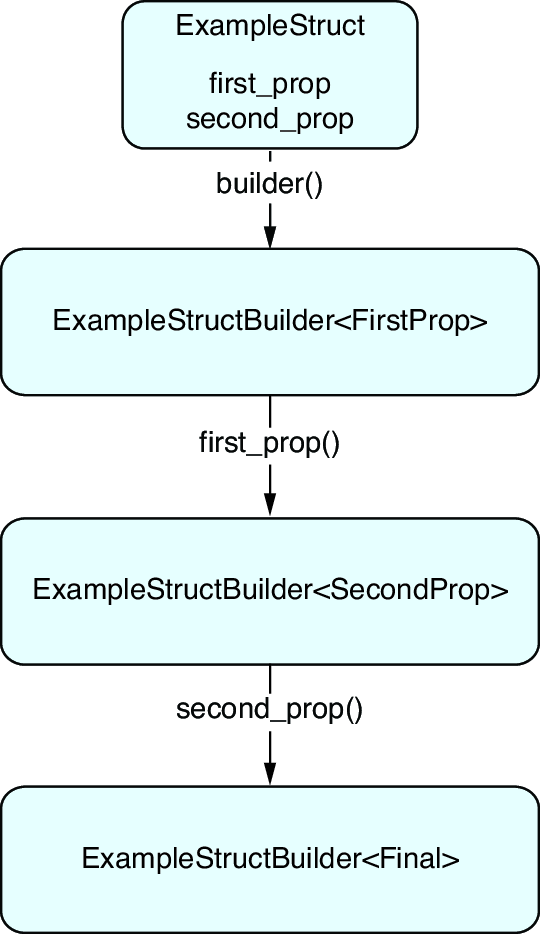
The state sequence makes the key constraint visible: only the builder reached through every required setter can call `build`. section 8.5.2
This approach favors an API that makes invalid configurations unrepresentable. It can also guide macro implementation: intermediate states can require all needed information before a final method produces output, while `#[must_use]` can warn when a required returned state is ignored. section 8.11 section 8.6

