Ubiquitous language is an unambiguous vocabulary that stakeholders and software developers share to express domain concepts and design decisions. It grows from the language people already use, but deliberately removes ambiguity: one term should not mean several things, and several terms should not quietly mean the same thing. The goal is not to impose a universal industry vocabulary. Definitions are meaningful within their domain and should be challenged and evolved as understanding improves. section 2.2.1 section 3.1.1
Use the language while discovering the problem, not only after a design is chosen. In collaborative modeling, domain experts, stakeholders, and technical participants make their meanings visible, test them together, and capture them in models. This creates alignment on both the domain and the decisions that shape a solution. A bounded context establishes where a particular model and its ubiquitous language stay consistent. section 1.2.1 section 2.2.1 section 2.2.3
Facilitate language cleanup as a group activity:
- Ask “What do you mean by …?” whenever a term seems assumed, overloaded, or disputed; use Socratic questions to surface silent disagreement. section 3.1.1 section 5.3.1
- Act as a translator across disciplines. Notice differences in communication style and check whether apparent agreement reflects shared meaning. section 5.3.1
- Record the terms domain experts use in a shared visual model or canvas, then revise wording as the conversation reveals better distinctions. section 2.3.1
- Make design decisions and their terminology explicit; revisit both as domain understanding becomes deeper. section 2.2.1 section 3.7
From “seats paid” to “Ticket Sold”
A ticket-purchase model initially described people as paying for seats. Modeling purchases for a themed day exposed the mismatch: not every ticket has a seat. The group chose Ticket Sold as the domain event and made seat optional. The change preserves a term that works across both movie and themed-day purchases, rather than encoding one case as the default. section 5.3.1
Figure 5.6 Domain language isn’t always clean. When there are multiple words referring to the same concept, misconceptions arise because of the language. Make these terms explicit during a collaborative modeling session.
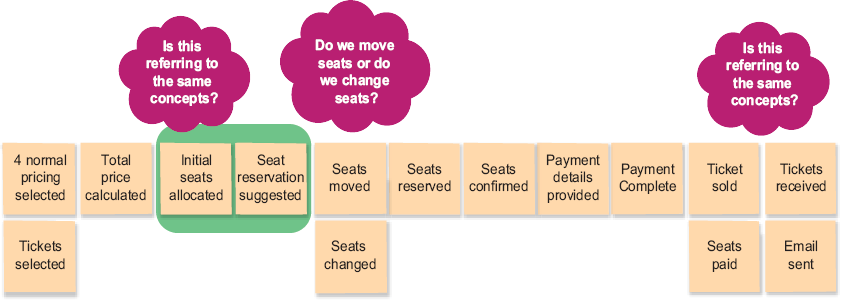
Use the diagram as a prompt to list competing terms for each concept, identify misconceptions, and agree on the wording the model will use. section 5.3.1
Ubiquitous language supports collaborative modeling and Domain-Driven Design, but neither is a substitute for participation. Without domain experts, a team may align internally while still misunderstanding the business problem. Treat language work as an ongoing conversation, not as a glossary completed once. section 1.2.1 section 2.2.3



