The Unified Medical Language System (UMLS) is a biomedical meta-thesaurus that maps concepts, names, codes, and semantic types across multiple controlled vocabularies. It provides a normalization layer for linking extracted medical mentions to stable concepts and then accessing related biomedical knowledge. section 7.5.2 section 7.1
A practical UMLS workflow uses the terminology system as an entry point for biomedical retrieval:
- Detect an ambiguous mention such as “Zika” and examine its surrounding context. section 7.1
- Map the mention to the appropriate UMLS concept unique identifier (CUI), distinguishing entities such as Zika virus, Zika virus infection, and congenital Zika virus infection. section 7.1
- Use the mapped concept to retrieve names, source codes, semantic types, broader concepts, narrower concepts, and relationships from biomedical ontologies. section 7.1 section 7.5.2
- Load UMLS alongside SNOMED and HPO in a knowledge graph, using UMLS identifiers to connect corresponding entities across ontologies. section 7.6.4
Terminology files and identifiers
The 2022AA UMLS release supplies MRCONSO.RRF for biomedical names, source vocabulary codes, and UMLS identifiers, and MRSTY.RRF for semantic types. The pipe-delimited records associate examples such as Dengue fever and Cephalgia with source systems including SNOMED CT, MeSH, and ICPC2ICD10ENG. A downstream NED model can use the resulting CUIs as links into the terminology graph. section 7.5.2
Figure 7.1 Screenshot from the UMLS website showing information about the Zika Virus entity. This information includes the name, the ID (concept unique identifier [CUI]), the semantic type, and a set of definitions, broader concepts, and narrower concepts.
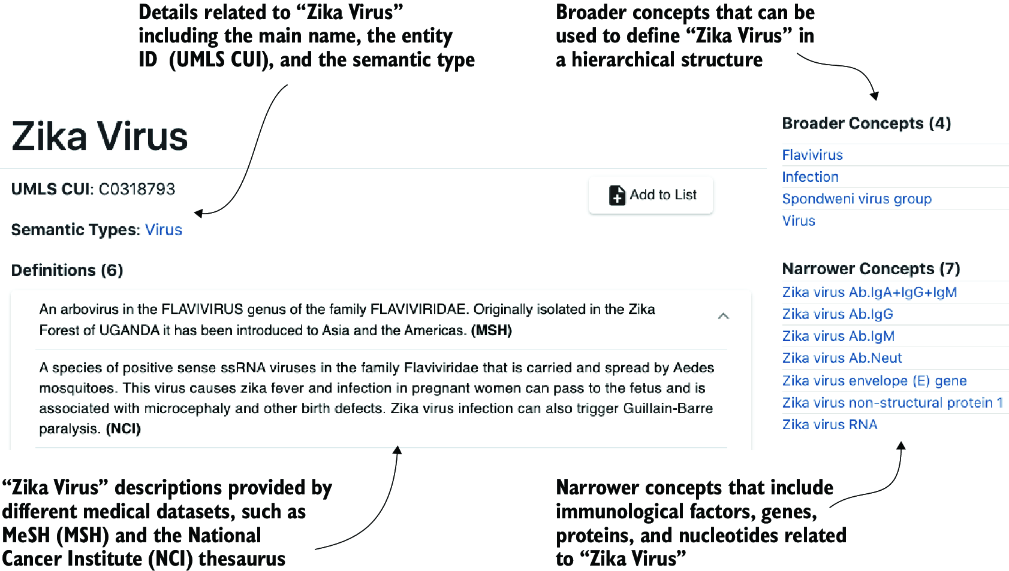
Inspecting a UMLS entity exposes its CUI, semantic type, definitions, broader concepts, and narrower concepts—the metadata needed for disambiguation and exploration. section 7.1
