liveBook · Manning

Unacceptable risk

As explained in Introduction to Generative AI, Second Edition

Unacceptable risk is a regulatory risk classification for AI applications considered incompatible with fundamental rights and therefore prohibited.

Unacceptable risk is the EU AI Act’s most severe regulatory category. It covers AI applications considered incompatible with fundamental rights and therefore prohibited rather than merely monitored or restricted. section 10.30

Prohibited examples include:

  • Cognitive or behavioral manipulation targeting people, especially vulnerable groups. section 10.30
  • Social-scoring systems. section 10.30
  • Real-time and remote biometric identification, with some law-enforcement exceptions. section 10.30

A violent-behavior toy

A voice-activated toy that encourages children to behave violently would fall into the unacceptable-risk category and be banned. section 10.30

Figure 10.7 The four risk categories in the AI Act
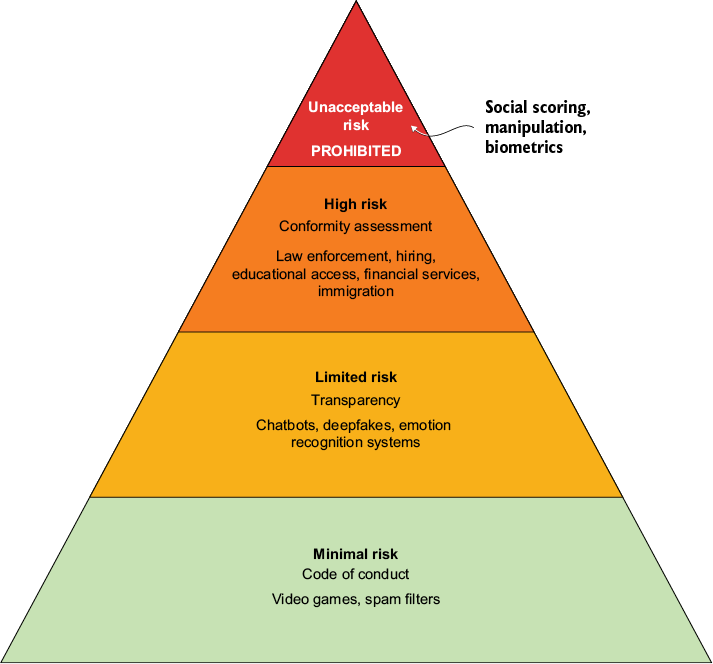
A pyramid of risk levels

AI-generated content may be incorrect.

Use the four-category overview to compare unacceptable risk with high-, limited-, and minimal-risk AI systems. section 10.30

How Introduction to Generative AI, Second Edition covers it

How deep it goes
Defines the category, gives prohibited examples, and contrasts prohibition with stricter oversight for high-risk systems.
Examples
Uses a violent-behavior voice-activated toy, social scoring, manipulation, and biometric identification as examples.
What it assumes
Assumes no technical background and defines the category through plain-language examples and fundamental-rights concerns.
What you can do after
Evaluate whether an AI application belongs to a prohibited category rather than a regulated high-risk category.
How it connects
Connects risk-based regulation with fundamental rights, behavioral manipulation, social scoring, biometric identification, and high-risk AI systems.

This explainer was generated by Manning's knowledge graph from the text of Introduction to Generative AI, Second Edition. The section links point to the parts of the book it draws on.