An unbounded medium carries wireless signals through open space rather than confining them to a cable. This enables mobility and flexibility, but makes transmission shared, exposed, and vulnerable to environmental conditions. section 18.1.1
Treat an unbounded medium as an operational networking constraint:
- Devices within sufficient range receive the signal, increasing privacy concerns and making encryption important. section 18.1.1
- Devices share airtime and operate in half-duplex mode; simultaneous transmissions can collide. section 18.1.1
- Wireless devices use Carrier-Sense Multiple Access with Collision Avoidance (CSMA/CA) to reduce collisions. section 18.5
- Interference, regulation, coverage limits, and signal loss constrain wireless deployment. section 18.5
Unlike bounded copper or fiber media, an unbounded medium radiates signals in all directions. Signals weaken through free-space path loss and can be altered by absorption, reflection, refraction, diffraction, or scattering. section 18.1.1 section 18.5
Figure 18.2 Similar to how frames are flooded to all devices connected to a hub, all devices within range of a wireless device receive its signals.
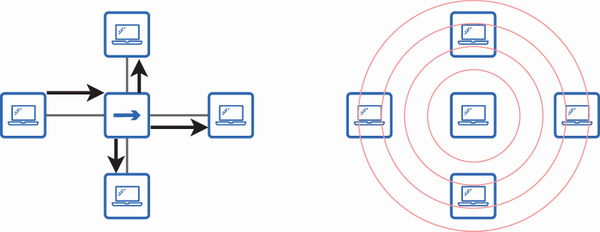
Use the figure to compare wireless reception with frame flooding through an Ethernet hub. section 18.1.1
Figure 18.3 The CSMA/CA process. To avoid collisions, a device will listen to ensure the channel is free before transmitting a frame.
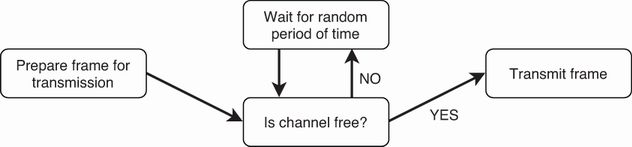
Use the figure to visualize how listening before transmission supports collision avoidance. section 18.1.1
