An undercomplete autoencoder reconstructs an input dataset through a compressed bottleneck with fewer dimensions than the input. Training penalizes reconstruction error, encouraging the network to retain the data’s most significant attributes rather than reproduce every detail. section 9.7
Use the bottleneck to understand the model’s practical behavior:
- Treat it as an unsupervised model: reconstruction supplies the training signal, so target labels are unnecessary. section 9.7
- Use the compressed representation for dimensionality reduction, then decompress it through the network to reconstruct the original data. section 9.7
- Expect nonlinear relationships when activation functions are present; with only linear layers, the autoencoder is equivalent to PCA. section 9.7
Figure 9.3 PCA is linear in nature while autoencoders are nonlinear. This is the core difference between the two algorithms.
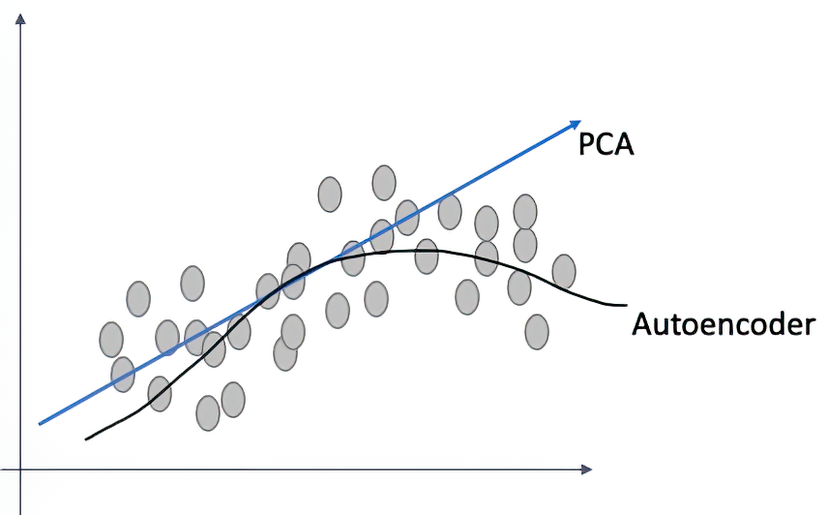
Compare PCA’s linear representation with the nonlinear representation learned by an undercomplete autoencoder. section 9.7
