liveBook · Manning

Underlay network

As explained in Acing the CCNA Exam: Volume 2 Advanced Networking and Security

An underlay network is the foundational physical or logical network that provides connectivity for an overlay network.

An underlay network is the foundational physical network that provides connectivity for an overlay network. Together, the physical underlay and virtual overlay form the network fabric. section 22.2.3

Identify the underlay by contrasting it with the virtual network built above it:

  • SD-Access uses a physical switch network as its underlay and VXLAN tunnels as its overlay. section 22.2.3
  • SD-WAN places IPsec tunnels over physical WAN underlays such as the internet, MPLS, cellular, or satellite. section 22.4
  • ACI uses a physical spine-leaf network as its underlay and VXLAN tunnels as its overlay. section 22.4
Figure 22.7 The Cisco SD-Access fabric, consisting of a physical underlay of switches and a virtual overlay of VXLAN tunnels. Cisco Catalyst Center is the SDN controller.
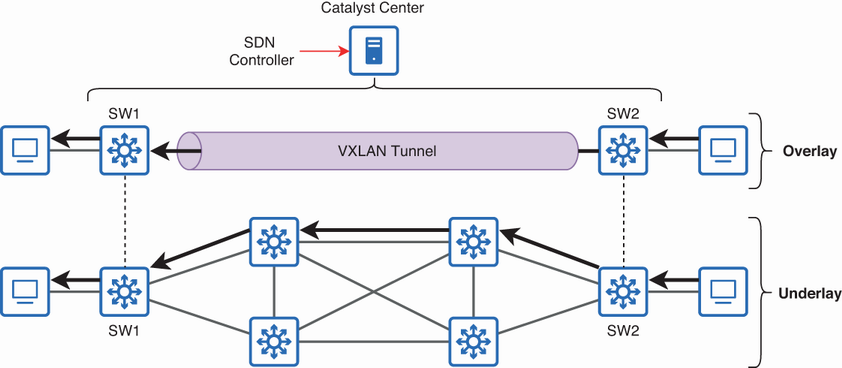
Visualizes the SD-Access fabric by separating its physical switch underlay, VXLAN tunnel overlay, and Catalyst Center controller. section 22.2.3

How Acing the CCNA Exam: Volume 2 Advanced Networking and Security covers it

How deep it goes
Defines the underlay-versus-overlay distinction and applies it across three Cisco architectures without detailing implementation procedures.
Examples
Uses switch networks, WAN links, and spine-leaf networks as underlays for VXLAN or IPsec overlays.
What you can do after
Evaluate/understand which physical network supports an overlay in SD-Access, SD-WAN, and ACI architectures.
How it connects
Connects underlay networks with overlay networks, network fabrics, SDN, VXLAN, IPsec, SD-Access, SD-WAN, and ACI.

Related concepts

This explainer was generated by Manning's knowledge graph from the text of Acing the CCNA Exam: Volume 2 Advanced Networking and Security. The section links point to the parts of the book it draws on.