A unified WLC is a dedicated hardware appliance that centrally controls lightweight access points (LWAPs) in a wireless LAN. It suits deployments where centralized control is needed beyond a small number of access points. section 19.2.2
Size the platform against the wireless deployment:
- Cisco hardware models support from a few hundred LWAPs up to 6,000 LWAPs and 64,000 clients with one WLC. section 19.2.2 section 19.3
- Deploy a second WLC when the network exceeds the supported capacity of one appliance. section 19.2.2
- Contrast the appliance with cloud WLCs, which are virtual machines, and embedded WLCs, which are integrated into switches. section 19.2.2
LWAPs use CAPWAP tunnels to communicate with the WLC: the control tunnel carries LWAP-WLC communications, while the data tunnel carries wireless client traffic. The WLC translates tunneled client frames into Ethernet frames in the appropriate VLAN. section 19.3
Figure 19.9 WLC deployment options. A unified WLC is a dedicated hardware appliance. A cloud WLC is a VM deployed in a private or public cloud. An embedded WLC is integrated into a switch. A Mobility Express WLC is integrated into an AP.
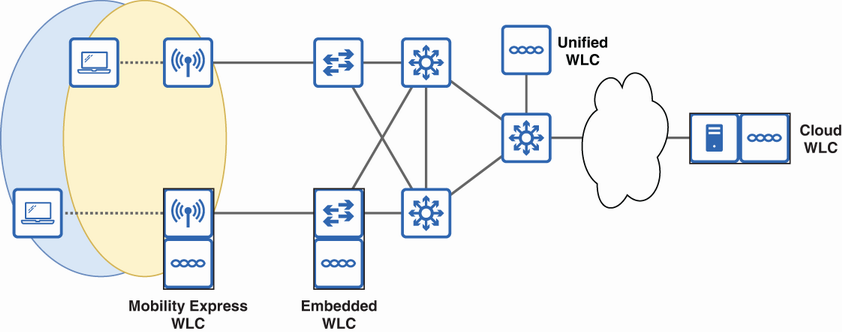
Compare unified, cloud, embedded, and Mobility Express WLC placement and capacity options. section 19.2.2
