Uniform initialization
Uniform initialization is C++ syntax that uses braces to initialize objects and values.
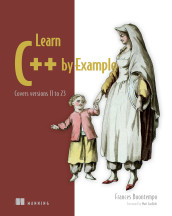
Learn C++ by Example
Brace initialization is C++ initialization syntax that uses braces to initialize objects and values.
- How it is used
- Uses brace syntax to initialize scalars, containers, random-number objects, and algorithm data consistently.
- How deep it goes
- Explains syntax, initializer-list behavior, constructor differences, and narrowing prevention, while deferring initialization's more complicated edge cases.
- Examples
- Demonstrates scalar initialization, vector construction, Pascal's triangle rows, and random prime generation.
- What you can do after
- Apply it via C++11-or-later brace syntax to initialize values and containers while detecting narrowing conversions.
Read how Learn C++ by Example explains uniform initialization →

100 C++ Mistakes and How to Avoid Them
Uniform initialization is C++ initialization syntax using braces that provides consistent initialization semantics and rejects narrowing conversions.
- How it is used
- Standardizes initialization of variables, containers, and in-class member defaults.
- How deep it goes
- Explains brace syntax, consistency, narrowing protection, and container use through practical examples.
- Examples
- Uses a vector and count variable, plus braced defaults for members of a Complex class.
- What you can do after
- Apply braces to initialize variables and containers consistently while rejecting narrowing conversions.
Read how 100 C++ Mistakes and How to Avoid Them explains uniform initialization →
What to know first
- C++C++ is a statically typed, general-purpose programming language that supports procedural, object-oriented, generic, and low-level systems programming.
- vectorA vector is an ordered sequence of elements treated as a single object, with its size fixed or resizable depending on the context.
Related concepts
- narrowing conversioncontrasts with · A narrowing conversion converts a value to a type with a smaller representable range or lower precision, potentially losing information.
- aggregate initializationcontrasts with · Aggregate initialization initializes an aggregate object from a brace-enclosed sequence of initializers for its elements or members.
- containeruses · A container is a logical or structural unit that holds, groups, or packages data or other elements as a single entity.
- vectoruses · A vector is an ordered sequence of elements treated as a single object, with its size fixed or resizable depending on the context.
- initializationkind of · The process of establishing initial values or a starting state for a program entity, component, resource, or computation before subsequent operation.
Questions about uniform initialization
What is uniform initialization?
Uniform initialization is C++ syntax that uses braces to initialize objects and values.
Which Manning books explain uniform initialization?
Learn C++ by Example and 100 C++ Mistakes and How to Avoid Them.
What should I know before learning uniform initialization?
Manning books that teach uniform initialization usually introduce C++ and vector first.
What is the difference between uniform initialization and narrowing conversion?
Uniform initialization is C++ syntax that uses braces to initialize objects and values. A narrowing conversion converts a value to a type with a smaller representable range or lower precision, potentially losing information.
What is uniform initialization a kind of?
Uniform initialization is a kind of initialization. The process of establishing initial values or a starting state for a program entity, component, resource, or computation before subsequent operation.
These guides are generated from the text of Manning books by Manning's knowledge graph and link to the sections they draw on. The full books are available on liveBook and at manning.com.