The uniform interface is a REST constraint that standardizes interactions around resources, their representations, HTTP methods, and metadata. It gives consumers a predictable way to understand resource capabilities and interpret responses. section 4.8.1
Represent API capabilities as resources and use HTTP methods rather than inventing operation-specific interfaces. This supports usability, security, extensibility, and interoperability, while keeping the API understandable and easier to evolve. section 4.8.2 section 15.6.1
Searching account transactions
Use GET /transactions/{accountId}?transactionId=2501 when the account identifies the resource and query parameters modify or filter it. Mixing accountId and transactionId ambiguously in one query, or replacing the resource with /search-transaction, makes the interface harder to understand and guess. section 9.4.1
Figure 9.4 Choosing user-friendly input data locations in an HTTP request depends on HTTP and common practice. Choosing appropriate locations facilitates the provision and understanding of input data.
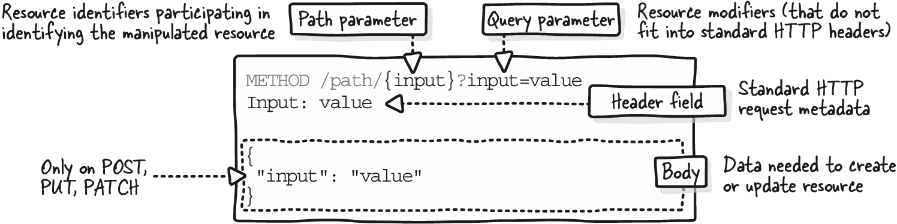
Use the request-location guide to compare path, query, header, and body choices for predictable HTTP operations. section 9.4.1
Apply the constraint by:
- Representing meaningful business concepts as appropriately sized resources. section 15.6.1
- Choosing input locations that follow HTTP behavior and common practice. section 9.4.1
- Combining the interface with ready-to-use data, flexible flows, and content negotiation to reduce breaking changes. section 15.6.1

