A unit cube is the multidimensional region whose coordinates range from 0 to 1 in every dimension. In optimization, it provides a normalized search space for candidate points. section 7.5 section 5.3.2
Use the unit cube to:
- Represent each candidate as a vector with one coordinate per tunable parameter. section 7.5
- Generate evenly distributed candidates before resizing them to the problem's actual bounds. section 5.3.2
Airplane design
An airplane-design objective uses four parameters scaled between 0 and 1, making the search domain a four-dimensional unit hypercube. Its bounds tensor is [[0, 0, 0, 0], [1, 1, 1, 1]]. section 7.5
Figure 5.14 Points from a Sobol sequence vs. uniformly sampled points in the two-dimensional unit square. The Sobol sequence covers the square more evenly and, therefore, should be used by TS.
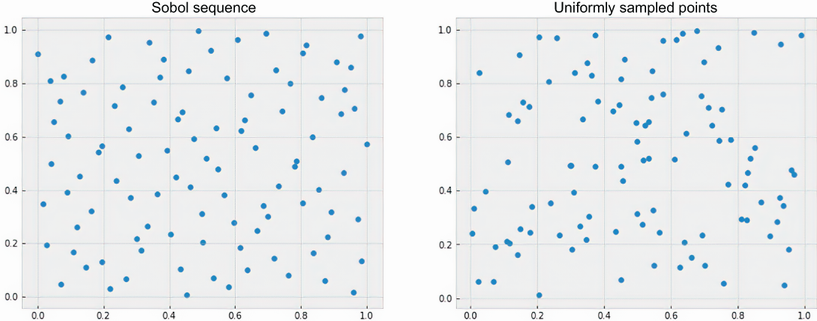
Compare Sobol and uniform points in a two-dimensional unit square to see why evenly covering the unit cube matters in higher-dimensional search. section 5.3.2
