The Universal Approximation Theorem states that a neural network with one hidden layer can approximate continuous functions to arbitrary accuracy. Its significance is expressive power: multilayer perceptrons can represent functions that a single perceptron cannot, such as XOR. section 7.3.4 section 7.6
A useful intuition approximates a curve with narrow rectangular towers. Increasing the number of towers improves accuracy; each tower can be assembled from shifted, flipped perceptron steps and combined in an MLP. section 7.5.3
The theorem establishes possibility, not practical efficiency:
- A single hidden layer is theoretically sufficient for continuous-function approximation. section 7.5.3
- The required number of perceptrons can become arbitrarily large, so deeper networks are often more practical. section 7.3.4 section 7.5.3
- Approximation does not guarantee accuracy on unseen data; training depends on representative labeled data and suitable weights and biases. section 7.6
Constructing a one-dimensional tower
Combine a left-shifted step, ϕ(x+5), with a flipped and right-shifted step, ϕ(−x+5), using ϕ(ϕ(x+5)+ϕ(−x+5)−1.5). The result forms a bounded tower; summing towers approximates a target curve. section 7.5.3
Figure 7.15 Generating a 1D tower with perceptrons.
|
(a) ϕ(x): positive w yields a regular step |
|
(b) Perceptron for a regular step |
|
(c) ϕ(−x): negative w yields a laterally flipped step |
|
(d) Perceptron for a laterally flipped step |
|
(e) ϕ(−x+5): changing the bias shifts the step left or right |
|
(f) Perceptron for a laterally shifted step |
|
(g) (ϕ(x+5)+ϕ(−x+5)−1.5): ANDing a left-shifted step with a flipped, right-shifted step yields a tower |
|
(h) MLP for a 1D tower |
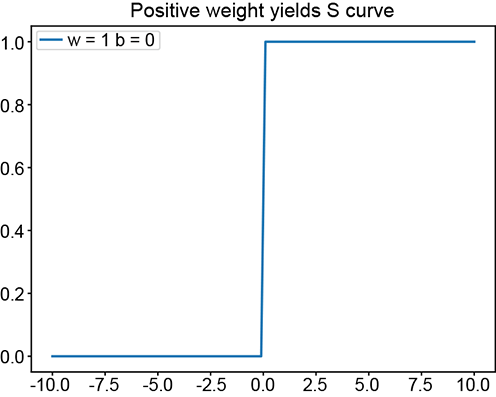
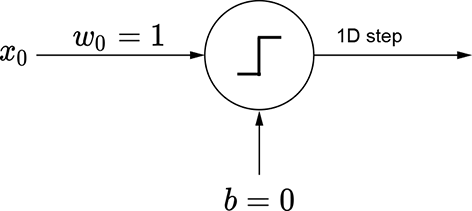
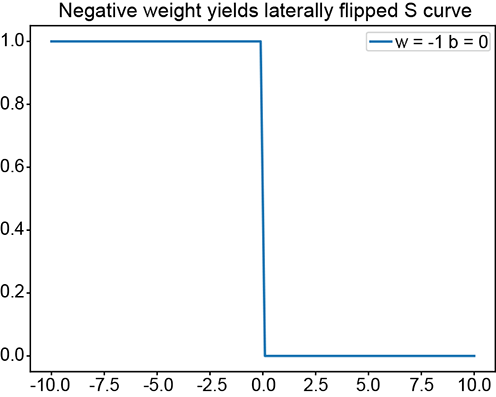
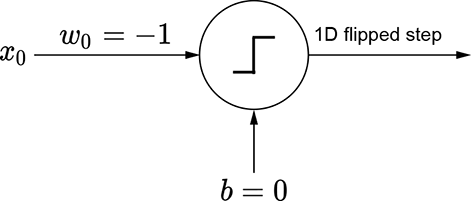
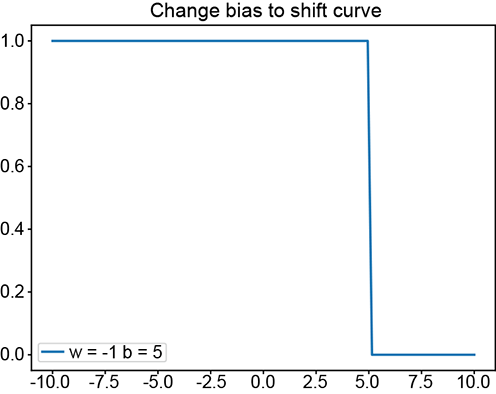
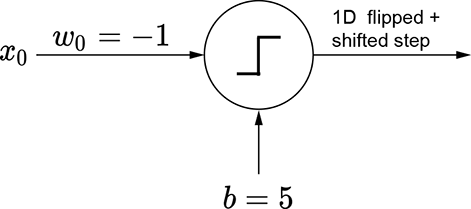
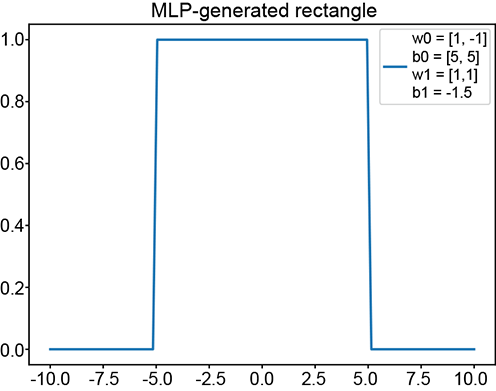
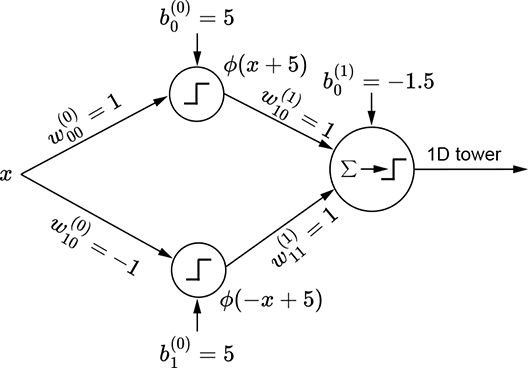
Use the construction diagram to trace how weights flip steps, biases shift them, and their combination creates a tower. section 7.5.3
