Unlabeled data has no designated target label. Whether a feature counts as a label depends on the question: pet images tagged with species or weight are labeled for those targets, while images without tags are unlabeled. section 2.1
Figure 2.1 Labeled data is data that comes with a tag, or label. That label can be a type or a number. Unlabeled data is data that comes with no tag. The dataset on the left is labeled, and the label is the type of pet (dog/cat). The dataset in the middle is also labeled, and the label is the weight of the pet (in pounds). The dataset on the right is unlabeled.
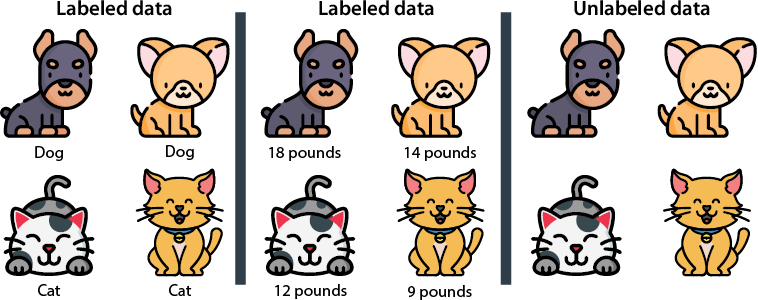
Compare pet datasets with species labels, weight labels, and no labels. section 2.1
Without labels, a model cannot predict which pet image is a cat or dog. It can still compare images and group similar ones, without knowing what each group represents. section 2.3
Grouping emails
An email dataset described by size and recipient count can be grouped by similarity, revealing categories without predicting a label. section 2.3



