Upper confidence bound (UCB) is a Bayesian optimization acquisition policy for choosing the next expensive evaluation. Rather than selecting only the location with the best predicted objective value, it acts optimistically: it selects the candidate whose plausible upper reward is highest. This transfers a decision rule from multi-armed bandits, where an agent chooses among uncertain slot machines, to optimization over a continuous search space. section 5.0 section 5.2
With a Gaussian-process predictive model, the objective value at a candidate has predictive mean μ and standard deviation σ. UCB assigns the acquisition score μ + βσ and evaluates the candidate with the largest score. The mean favors locations already predicted to perform well; the uncertainty term gives poorly known locations an optimistic score, creating an exploration–exploitation trade-off. section 5.2.1 section 5.2.2
Figure 5.6 The UCB of a GP that corresponds to the 95% CI. This bound can be used as the acquisition score of the UCB policy.
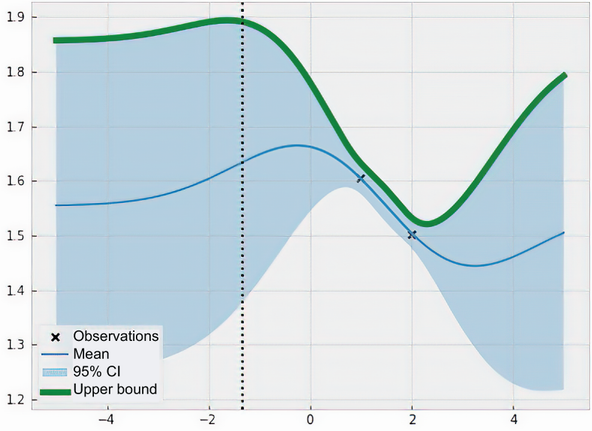
The upper edge of the predictive confidence interval becomes the acquisition landscape. Its highest point is the next query, even when that point is uncertain rather than having the highest mean. section 5.2.1
Tune β to control how optimistic the policy is:
- Use a smaller β for more exploitation: the score stays closer to the predictive mean and tends to remain in known high-reward regions. section 5.2.2
- Use a larger β for more exploration: uncertainty contributes more strongly, so the policy is more likely to query away from observed data. section 5.2.2
- Avoid treating β as universally optimal. On the Forrester function, β = 1 became stuck at a local optimum, while β = 2 found the global optimum; excessive exploration can also hurt performance. section 5.2.3
- Consider increasing β as observations accumulate and GP uncertainty tightens, preventing the score from collapsing toward mean-only exploitation. section 5.4.1
Using UCB in a BayesOpt loop
With BoTorch, construct an UpperConfidenceBound policy from a GP model and a positive beta value, then optimize its acquisition score to obtain the next candidate. Replacing another acquisition policy with UCB requires only this policy change in the loop. A hyperparameter-tuning exercise compares fixed β values and an adaptive schedule on a simulated support-vector-machine accuracy surface. section 5.2.3 section 5.4.2
For parallel evaluations, do not simply choose the top sequential UCB scores. Batch BayesOpt reformulates a policy’s utility over the joint multivariate Gaussian predictions for all points in a batch, using the batch’s maximum quantity of interest before averaging. section 7.2.1

