An upward dependency occurs when a lower software layer depends on a higher one—for example, when an infrastructure repository directly updates a presentation-layer status label. section 4.3.2
That shortcut creates costly coupling:
- It tangles responsibilities, makes the infrastructure layer harder to replace, and complicates isolated testing. section 4.3.2
- It can also create circular dependencies, making the system brittle and difficult to understand. section 4.3.2
A lower layer can return data, such as a success value or saved object, to the Application Layer. The application service can then decide how to notify the presentation layer without reversing source-code dependencies. section 4.3.2
Figure 4.5 In a clean architecture, dependencies must only flow downward to the adjacent layer. Breaking this rule by "skipping" layers or creating upward dependencies (e.g., the Infrastructure Layer talking directly to the UI) creates a tangled web that makes the system impossible to test or modify without breaking everything.
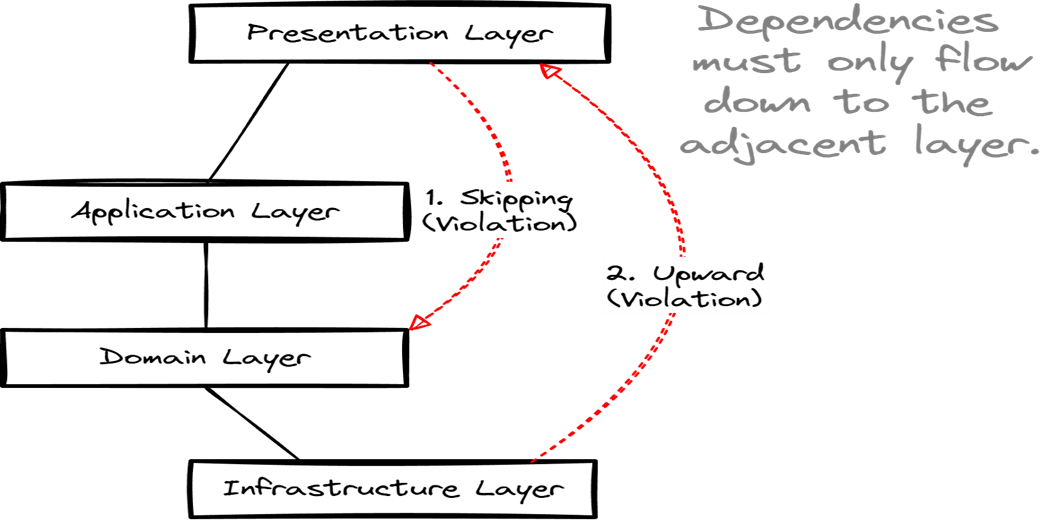
The figure contrasts downward dependencies with upward and layer-skipping violations. section 4.3.2
