User attitude captures how users feel about something, including their opinions, judgments, perceptions, and expressed feedback. It differs from user behavior, which records what people actually do. section 4.2.2
Stated attitudes and observed behavior do not always align. Treating both as useful evidence helps reveal usability problems, missing features, and expectations that observation alone may miss. section 4.2.2
Use attitude evidence alongside behavioral evidence:
- Compare what users say with actions recorded through analytics or other behavior studies. section 4.2.2
- Investigate contradictions instead of choosing one source automatically; the mismatch may expose confusion or an unclear design. section 4.3 section 4.2
- Combine methods throughout the project so design decisions remain grounded in user needs. section 4.3
A call-to-action mismatch
Analytics show that users rarely click the main call-to-action or take too long to click it. Interviews indicate that users consider the call-to-action easy to find. Comparing the behavior with the attitude helps clarify the design problem and identify changes that could increase clicks. section 4.2.2
Figure 4.4 A range of user research methods and where they fall on the spectrum of qualitative vs. quantitative and behavior vs. attitude focused
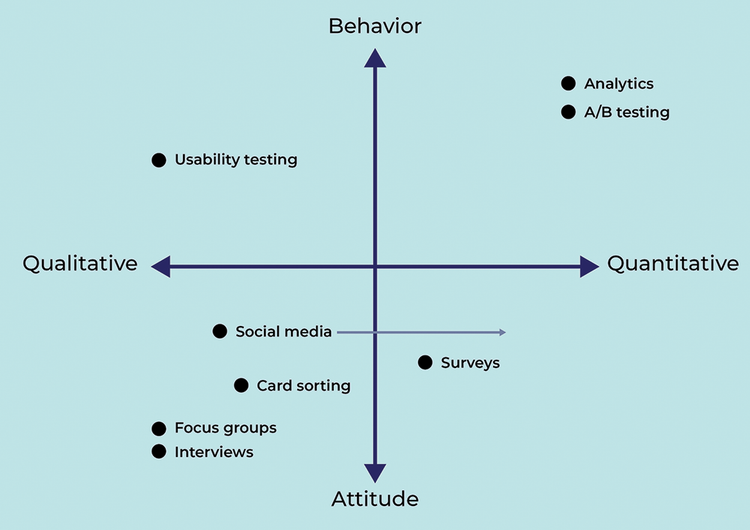
A research-methods map positions attitude and behavior alongside qualitative and quantitative approaches, helping teams choose complementary evidence. section 4.2
