A user-item recommendation ranks items for a particular user by learning preference or similarity relationships between users and items. It can support a product page, a recommendation feed, or personalized keyword search. section 4.2.5 section 9.3.3
Two mechanisms are especially useful. A content-based recommender matches user attributes or prior item attributes against item properties such as category, text, brand, color, or size. Collaborative filtering instead uses interaction patterns to surface items related to a user's interests, including items the user has not directly encountered. section 9.2.1 section 9.3.3
A user-item recommendation pipeline can:
- Collect interactions such as queries and clicks, then associate them with users and target items. section 4.2.5
- Generate a user-to-item collection containing recommended products and relative relevance boosts. section 9.3.3
- Serve recommendations directly with no keyword query, or apply them as boosts to ordinary search results. section 9.3.3
Personalizing a tablet search
Suppose a user searched for Apple and clicked an iPad. Retrieve that user's recommendations, convert each product and boost into a boost query, and apply it to a search for "tablet". The resulting ranking can favor Apple products for this user while still surfacing similar tablets from competing manufacturers.
Figure 4.8 Many reflected intelligence models. The leftmost box represents user-to-item similarity for recommendations, the next shows learning specific attribute-based preferences for a user’s profile, the third shows learning item-to-item–based similarity for recommendations, and the rightmost shows learning query-to-item recommendations.
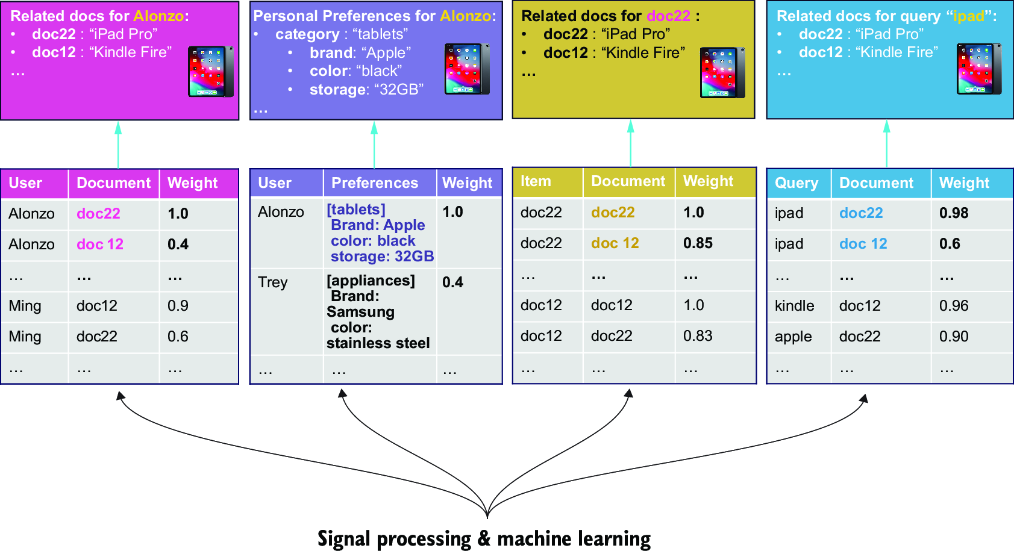
Map user-to-item similarity alongside item-to-item similarity, attribute-based profiles, and query-to-item recommendations. section 4.2.5
