A userspace environment is the collection of system libraries, utilities, files, binaries, and other dependencies that applications use above the operating-system kernel. Containers commonly package this environment with the application so behavior stays consistent across hosts with the same CPU architecture. section 7.1
Userspace environments matter when comparing traditional containers with Wasm packaging:
- Containers share the host kernel but bundle an application with its userspace environment, dependencies, and container runtime. section 7.1
- Packaging the same userspace environment lets an application use Ubuntu libraries and utilities on Ubuntu, another Linux distribution, or Windows. section 7.1
- Wasm containers generally load the application and necessary dependencies without initializing a traditional userspace environment, reducing startup and image overhead. section 7.3.2
Container versus Wasm startup
A Docker container may initialize its packaged userspace environment before running an application. A Wasm container launched through containerd and Wasmtime loads the application instead, producing faster cold starts and smaller binaries for constrained edge or IoT deployments. section 7.3.2
Figure 7.1 The typical architecture of a containerized system, illustrating how applications are packaged with their dependencies and userspace environment, all managed by the Docker engine on top of the host operating system
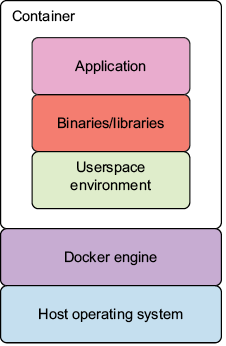
Use the architecture diagram to locate the userspace environment between the packaged application and the Docker engine over the host operating system. section 7.1
