liveBook · Manning

Utterance labeling system

As explained in Natural Language Processing in Action, Second Edition

An utterance labeling system is software for assigning annotations or intent labels to user utterances.

An utterance labeling system helps chatbot teams turn user messages into training data. A reviewer can add a misunderstood utterance to a set of acceptable answers and assign the appropriate intent label. section 12.6

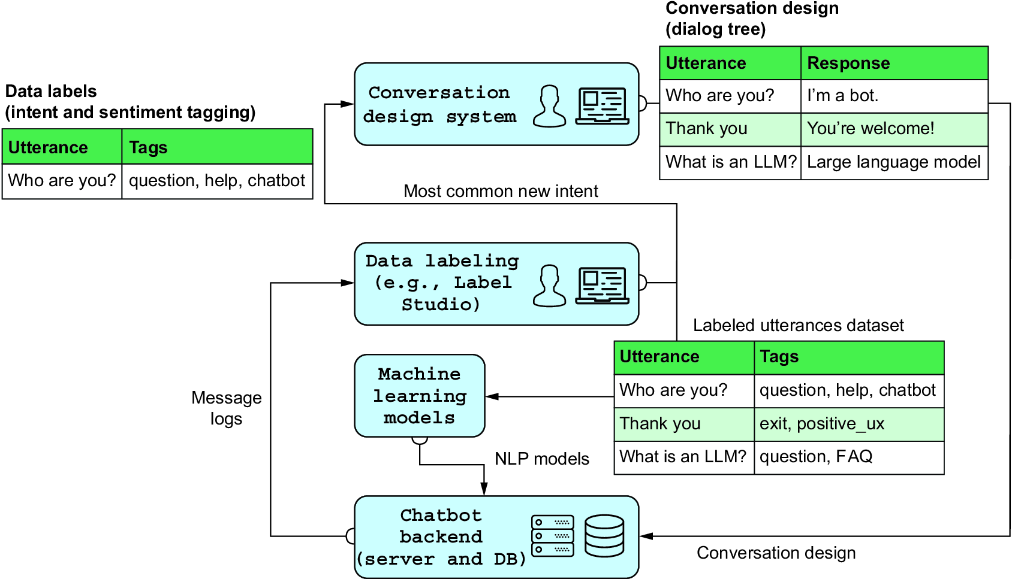
The system sits between conversation design and machine-learning training: labeled utterances are passed to models, while message logs reveal where new labels or dialog branches may be needed. section 12.6

Correcting a chatbot misunderstanding

If a chatbot marks a student’s answer as incorrect because it misunderstood the utterance, add that answer to the possible correct responses and label it with the appropriate intent. section 12.6

Figure 12.6 Conversation design workflow
figure

The conversation design workflow shows how labeling, model training, backend interaction, message logs, and ongoing design revisions connect. section 12.6

How Natural Language Processing in Action, Second Edition covers it

How deep it goes
Explains its workflow position and feedback role but stops short of implementation details or labeling procedures.
Examples
Uses Label Studio and a misclassified student answer as concrete labeling examples.
What it assumes
Assumes familiarity with chatbot dialogs, intents, labeled datasets, and machine-learning models.
What you can do after
Apply via an utterance labeling tool to correct recognized intents and improve future chatbot model training.
How it connects
Connects intent labeling with natural-language understanding, machine learning, conversation design, chatbot backends, and message logs.

This explainer was generated by Manning's knowledge graph from the text of Natural Language Processing in Action, Second Edition. The section links point to the parts of the book it draws on.