A product can use AI and still give customers no reason to use it. Value is the improvement a product provides to users or a business: easier access to information, less manual work, better outputs, or a more useful experience. Start with a real need, pain point, or desire—not excitement about the technology. Then ask whether AI adds enough benefit to justify its infrastructure, development, and specialized skills over a traditional solution. section 1.3.1
From fixed dashboards to useful answers
A dashboard shows a designer-selected slice of data in a fixed format. Conversational access lets users draw on a wider range of existing data and focus on what matters at that moment. That flexibility can make the product more useful to customers and support higher pricing or wider adoption—but only if it addresses something they need. section 1.3.1
Assess a proposed AI feature from more than one angle:
- Identify the user outcome. Consider efficiency, improved quality, personalization, convenience, innovation, or emotional engagement rather than treating the AI feature itself as the benefit. section 12.3.1
- Look beyond minutes saved. Ask what higher-value work users cannot do while a task remains manual, and whether assistance could improve accuracy or consistency. section 10.1.1
- Prioritize where user impact, business value, and technical feasibility align; for a specific task, also test whether users want the proposed automation. section 2.4 section 10.1.1
- Validate before committing, especially when mistakes carry high stakes. User interviews, market research, feasibility tests, ROI estimates, and regulatory review can reduce uncertainty, though extensive preparation takes time. section 2.3.1
Figure 10.3 Look for automation potentials at the intersection of objective value, feasibility, and subjective desirability.
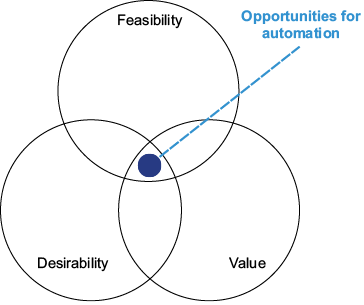
The figure places automation potential where value, feasibility, and desirability intersect: a valuable task alone is not enough to make a good AI opportunity. section 10.1.1
Make a productivity claim concrete
If ten planners each spend two hours a week aggregating data, the team spends 20 hours. Reducing that work to ten minutes per planner saves about 18.33 hours weekly. At $50 per hour, that is about $916.50 a week in employee time. Explain what planners can do with the freed time—such as focus on strategic decisions—rather than stopping at the savings figure. section 12.3.1
Communicate value as a change in a customer’s work or life, not as a claim about AI capability. Quantify benefits where possible, but keep the distinction between a plausible benefit and one validated with users. Quick wins can deliver immediate impact; longer-term opportunities may warrant investment when they offer a stronger competitive edge. section 12.3.1 section 2.4






