A value chain connects a user need to the components that make meeting it possible. Those components depend on one another: a change in one may affect others. Mapping these relationships gives business and technology teams a shared view of how value is delivered and where architecture decisions may matter. section 5.4.2 section 5.0
To build value chains for a Wardley Map:
- Define the map’s purpose and scope. A whole business and an individual capability call for different levels of detail. section 5.2
- Identify the users and state what each needs. section 5.2
- Construct a chain of components for each user need, then place the components on the map according to their stage of evolution. section 5.6
Online food delivery
A delivery marketplace serves customers, restaurants, and riders. A macro-level map starts with those users and their needs, such as connecting hungry people with local takeaway food and enabling restaurants to offer an efficient takeaway service. Chains built from each need can then expose the components the service relies on. section 5.2
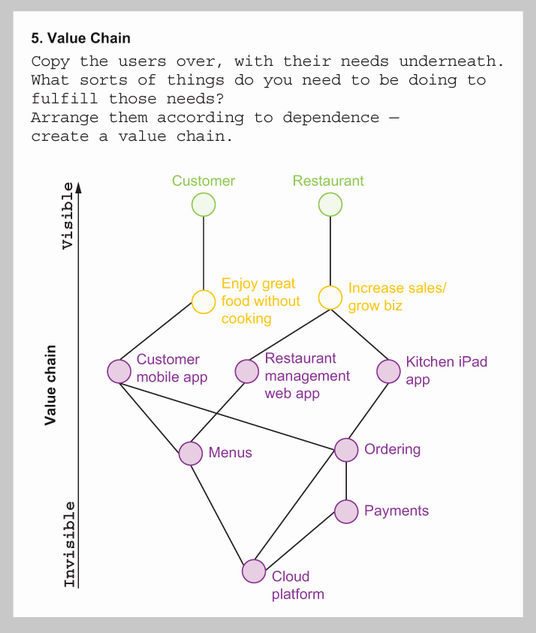
The value-chains area of the Wardley Mapping Canvas provides a place to assemble components around user needs before positioning them on a map. section 5.2
A chain is not a fixed inventory. Components can evolve together, and changes in their dependencies can create risks or opportunities. Revisit the map as understanding improves; deeper domain exploration can help refine it rather than treating the first workshop as the final answer. section 5.4.2 section 5.6
