A value function estimates how much reward remains from a state. For a state s at time t, it is the expected discounted return: V(s) = E[G_t | S_t = s]. The discount γ balances near- and long-term rewards: γ = 0 keeps only immediate reward, while γ = 1 weights future rewards equally. In language-model RL, a state is a prompt plus the generated prefix, and each next token is an action. section 6.2 section 5.6.1
The estimate is policy-dependent: V^π(s) predicts return when continuing with policy π. Policy-gradient objectives weight state values by how often the current policy visits them, but implementations estimate this from sampled on-policy rollouts rather than enumerating states. Thus a value prediction must track a changing policy and changing rollout targets. section 6.2 section 5.6
In actor–critic training, the value network is the critic: an additional model copy or scalar regression head that predicts V_t at every completion token. Its main job is to provide a baseline for an advantage estimate, A_t = R̂_t − V_t. The advantage says whether observed return was better or worse than the critic expected, reducing variance in the policy update while preserving token-level credit assignment. section 6.2.7 section 6.2.1 section 6.2.4
A basic PPO value-learning pipeline is:
- Generate on-policy completions and obtain per-token rewards; in language-model PPO, these can include per-token KL penalties. section 6.2.7
- Compute discounted Monte Carlo returns backward from each token, resetting at terminal positions. section 6.2.7
- Regress each prediction V_t toward its return target, commonly with mean squared error and optionally clipped value predictions. section 6.2.7
- Detach A_t = G_t − V_t and use it to weight the policy-gradient loss. section 6.2.7
Figure 6.6 Value function training uses on-policy rollouts to compute targets. The model predicts \(V_t\) at each token, which is trained via mean squared error against the target return \(\hat{V}_t\). The advantage \(A_t = \hat{V}_t - V_t\) then weights the policy gradient update.
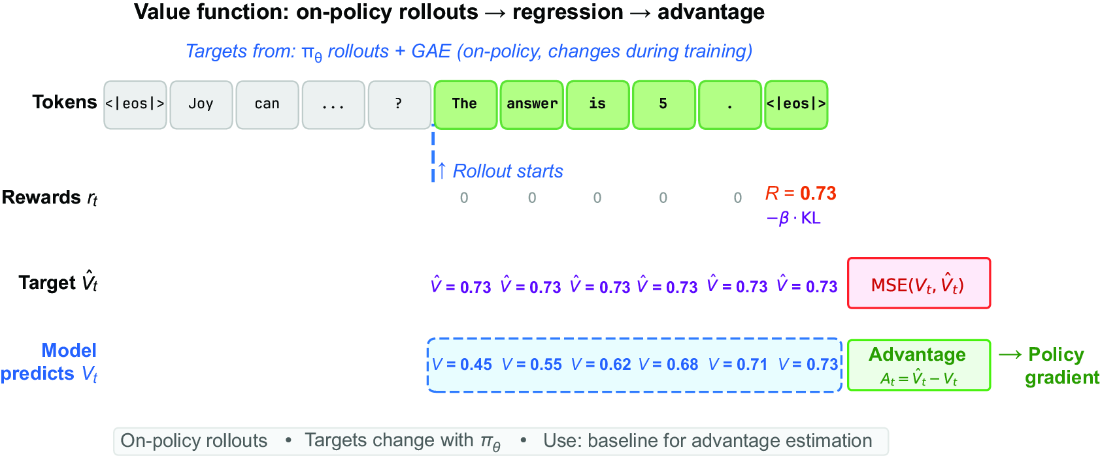
The rollout-to-target-to-advantage flow separates critic fitting from the policy update: returns supervise V_t, and prediction errors weight policy gradients. section 6.2.7
A value function is not an outcome reward model (ORM), even when both use a per-token head. An ORM predicts an immediate token-local reward or probability of correctness from fixed offline labels. A value function predicts the remaining sum of rewards from the current state and is typically trained against on-policy rollout returns. With dense correctness rewards and γ = 1, the former learns r_t while the latter learns the remaining sum from t onward. section 5.6 section 5.6.1
Choosing a critic versus a sequence baseline
PPO uses a learned value network to assign different advantages to individual tokens, incorporating per-token KL penalties before computing A_t. REINFORCE and RLOO avoid a learned critic: RLOO uses other completions for the same prompt as a leave-one-out baseline, then broadcasts a sequence-level advantage across tokens. This saves the extra model copy but loses PPO's token-level value estimates. section 6.2.4 section 6.6

