Variable-length subnet masking (VLSM) divides an IPv4 address block into subnets of different sizes, matching each subnet to its address requirement and reducing waste. section 11.2
Apply VLSM by assigning subnets from largest to smallest:
- Order requirements by host count, then assign the largest subnet at the beginning of the address block. section 11.3
- Place each subsequent subnet immediately after the previous subnet’s broadcast address. section 11.5
- Calculate each subnet’s network address, broadcast address, usable range, and host capacity. section 11.5
10.89.100.0/24 allocation
Allocate /25 for 122 hosts, /26 for 59, /27 for 30, /28 for 11, and /30 for a two-router WAN link. Twelve addresses remain available for growth. section 11.3
Figure 11.13 The 10.89.100.0/24 address block, divided into five subnets of varying sizes. (1) Toronto LAN A is 10.89.100.0/25, containing 128 addresses. (2) Tokyo LAN A is 10.89.100.128/26, containing 64 addresses. (3) Toronto LAN B is 10.89.100.192/27, containing 32 addresses. (4) Tokyo LAN B is 10.89.100.224/28, containing 16 addresses. (5) The WAN connection is 10.89.100.240/30, containing 4 addresses. After subnetting, 12 addresses remain unused: 10.89.100.244 through 10.89.100.255.
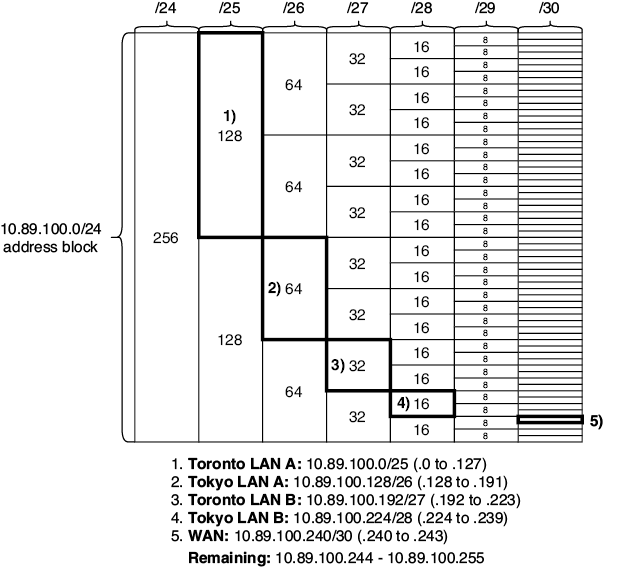
Visualize how one /24 block becomes five contiguous subnets with different prefix lengths. section 11.3
