A variational parameter specifies part of a variational approximation in a variational Gaussian process (VGP). Unlike regular parameters such as a mean constant or covariance length scale, it is associated with probability distributions and the inducing points used to construct the approximation. Its behavior is therefore not well represented by ordinary Euclidean distance. section 12.3
Figure 12.14 An example of how the loss to be minimized might behave very differently with respect to a regular parameter and a variational parameter. This gives rise to the need to take into account the geometry of the loss.
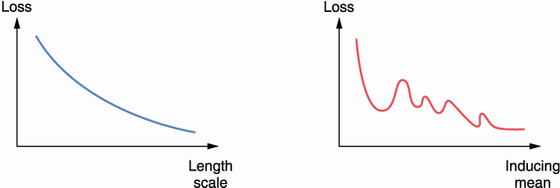
The loss can behave very differently along a regular parameter and a variational parameter, motivating optimization methods that account for loss-surface geometry. section 12.3
Variational parameters matter during VGP training because:
- A change in an inducing point's mean is not equivalent to the same numerical change in a covariance length scale, even when both changes have equal Euclidean size. section 12.3
- Natural gradient descent uses the geometry of the loss with respect to variational parameters, while mini-batch gradient descent optimizes regular parameters such as length and output scales. section 12.5
- In GPyTorch, variational parameters can be exposed through model.variational_parameters() and updated with gpytorch.optim.NGD alongside an Adam optimizer for hyperparameters. section 12.3
