liveBook · Manning

Verifier

As explained in Elliptic Curve Cryptography for Developers

A verifier is the party in a proof protocol that checks whether the prover's claim and evidence satisfy the required conditions.

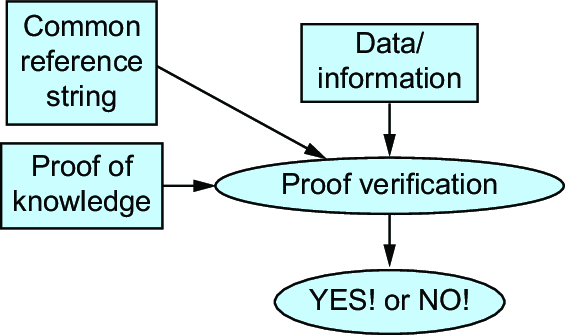
A verifier checks whether a prover’s claim and evidence satisfy the protocol’s conditions without learning the private witness. In a noninteractive zero-knowledge proof, it combines public data, a public common reference string, and a public proof of knowledge to return YES or NO. section 1.3.4

A verifier’s inputs and checks include:

  • Public data, such as information associated with a blockchain. section 1.3.4
  • A public common reference string containing elliptic-curve parameters used to hide data. section 1.3.4
  • A proof of knowledge generated from public and private inputs, while the private witness remains undisclosed. section 1.3.4
  • QAP relationships whose wire values and multiplication gates must satisfy the required equations; failure causes rejection. section 19.2 section 19.7
Figure 1.9 The process of verifying a zero-knowledge proof
figure

Follow the verification flow from public data, reference string, and proof to a YES or NO result. section 1.3.4


How Elliptic Curve Cryptography for Developers covers it

How deep it goes
Describes verification inputs and QAP equation checks, but stops short of implementation code or a complete verifier algorithm.
Examples
Uses blockchain data, anonymous transactions, certificates, and a medical record proving medicine and dose without identifying the patient.
What it assumes
Assumes public and private inputs, elliptic-curve parameters, finite-field wire values, and basic zero-knowledge terminology.
What you can do after
Evaluate whether a proof is consistent with public data and return acceptance or rejection without exposing the witness.
How it connects
Connects zero-knowledge proofs with provers, witnesses, SNARKs, QAPs, pairings, and common reference strings.

Also explained in

Compare how 4 books explain verifier →

Related concepts

This explainer was generated by Manning's knowledge graph from the text of Elliptic Curve Cryptography for Developers. The section links point to the parts of the book it draws on.

