A virtual CPU (vCPU) is a virtualized processing unit allocated to a cloud computing instance. Cloud providers package vCPUs with memory in predefined machine types, instance types, or sizes. section 12.1.1
Treat vCPU capacity as both a performance setting and a cost-control boundary. If production needs at most 32 vCPUs, infrastructure policy can reject any configured server whose provider-defined capacity exceeds that limit. section 12.1.1
A practical vCPU control workflow:
- Parse server definitions from infrastructure as code and identify each machine type. section 12.1.1
- Query the provider API or client library for the machine type’s current CPU and memory values. section 12.1.1
- Fail the test when a server exceeds the approved vCPU ceiling, preventing an unused increase from reaching delivery. section 12.1.1
- Estimate CPU-related monthly cost before changing machine types, then compare the total with a budget. section 12.1.2
A 32-vCPU production limit
A conference environment uses no more than 32 vCPUs. Increasing a server to 48 vCPUs raises the bill by 50% without corresponding usage, so a policy test queries the GCP API and rejects the configuration. section 12.1.1
Figure 12.2 Your test should parse machine types from server configurations, check the GCP API for the number of CPUs, and verify they do not exceed the limit.
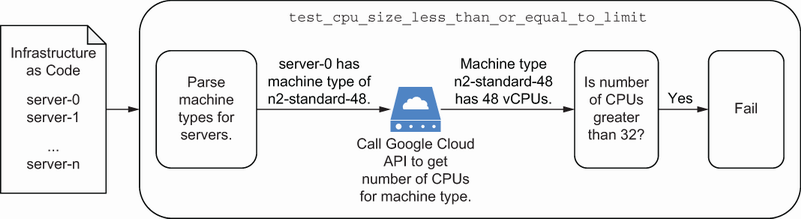
Trace how server configuration is parsed, provider capacity is retrieved, and the vCPU limit is enforced in the delivery pipeline. section 12.1.1
