liveBook · Manning

Visibility axis

As explained in Architecture Modernization: Socio-technical alignment of software, strategy, and structure

A visibility axis is the vertical dimension of a Wardley map that represents how apparent a component is to the user.

The visibility axis is the vertical dimension of a Wardley map. Components placed higher are more apparent to users; components placed lower may be unseen or unknown to them. section 5.2

Use the axis to distinguish:

  • User-facing capabilities, such as a customer mobile app. section 5.2
  • Underlying capabilities, such as a cloud platform that customers do not see. section 5.2

Restaurant ordering

Customers see and interact with the mobile app, while the restaurant’s cloud platform supports server-side components without appearing to customers. Both occupy the same value chain at different visibility levels. section 5.2
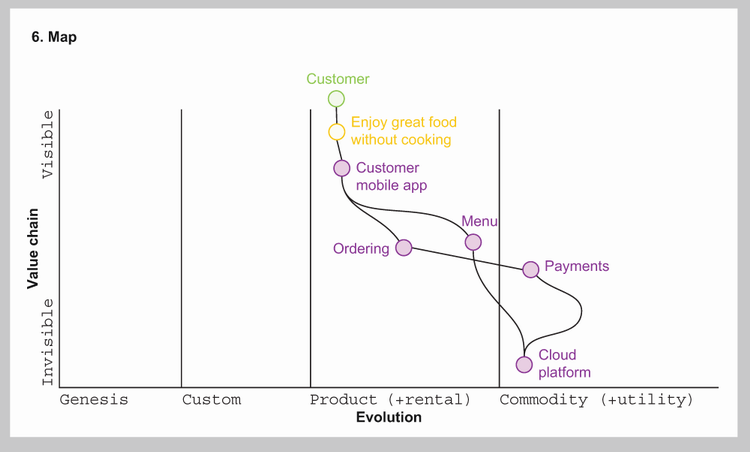
Figure 5.7 Step 6 of the Wardley Mapping Canvas, a Wardley Map

Inspect the completed Wardley Map to see visibility represented alongside value chains and evolution stages. section 5.2

How Architecture Modernization: Socio-technical alignment of software, strategy, and structure covers it

How deep it goes
Defines visible and invisible placement through user-facing and underlying examples.
Examples
Uses a customer mobile app, restaurant management app, kitchen iPad app, ordering component, and cloud platform.
What you can do after
Evaluate which components users encounter directly and which remain hidden infrastructure.
How it connects
Connects user needs, value chains, Wardley maps, and evolution stages.

Related concepts

This explainer was generated by Manning's knowledge graph from the text of Architecture Modernization: Socio-technical alignment of software, strategy, and structure. The section links point to the parts of the book it draws on.