The deep learning development cycle is a product workflow for taking a deep learning opportunity from business planning to a customer-facing application. It treats models, data, deployment, and product work as connected concerns rather than isolated engineering tasks. A deep learning system supplies the infrastructure that lets these stages progress efficiently and gives teams a shared way to address their distinct operational needs. section 1.0 section 1.1
Figure 1.1 A typical scenario to bring deep learning from research to a product. We call this the deep learning development cycle.
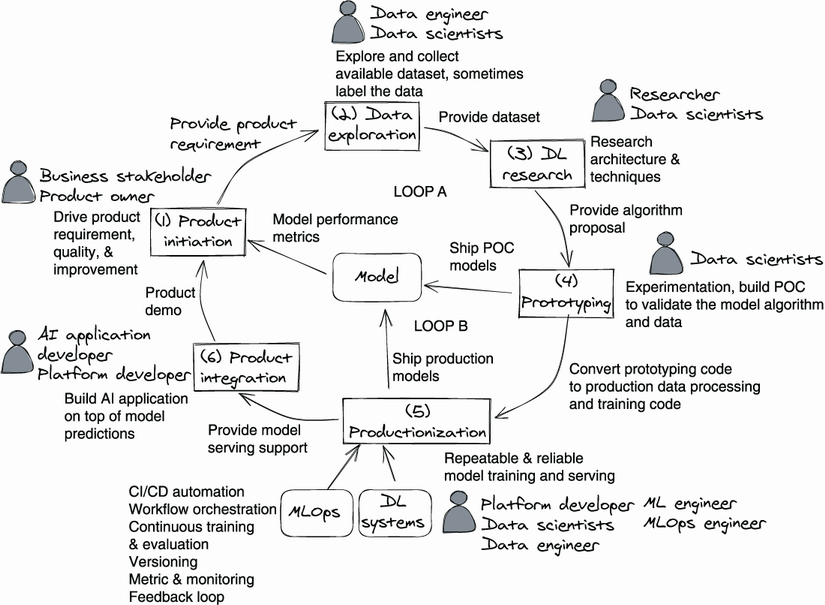
Use the workflow diagram to orient stakeholders around the route from research to a finished product and the roles participating along it. section 1.1
A typical cycle proceeds through five linked stages:
- Product initiation starts when a product owner or project manager identifies a business opportunity or problem that machine learning may address. section 1.1.1
- Data exploration turns business requirements into usable datasets through collection, cleaning, labeling, and analysis with data scientists and data engineers. section 1.1.1
- Research and prototyping evaluates feasible algorithms and approaches against the available data and business requirement. section 1.1.1
- Productionization ships a worthwhile product that can serve requests, handle expected load, and respond gracefully to malformed input or overload. section 10.0
- Application integration connects the resulting capability to the end product customers use. section 1.1.1 section 10.0
Data exploration is deliberately early and relatively unstructured: teams may use Python or shell scripts, manual transfers, or analysis environments such as Jupyter Notebook, Amazon SageMaker Data Wrangler, and Databricks before building a formal collection pipeline. Its quality matters because more relevant data increases the likelihood of effective and efficient models. section 1.1.1
The cycle also frames MLOps. Teams often assemble separate packages for training, serving, performance tracking, and experimentation for each application; repeatedly doing so is slow and inconsistent. A common lifecycle supports quicker, more reliable delivery while clarifying why a platform must serve product, data, modeling, operations, and application roles together. section 1.1
A deep learning system reduces cycle complexity by providing coordinated capabilities for dataset management, model training, model serving, metadata and artifact storage, workflow orchestration, and a data science environment. This can let a data scientist build scalable models, establish data pipelines, and deploy and monitor models without becoming an expert in every adjacent specialty. section 1.4 section 1.4
Use a reference architecture as a starting point, then collect goals and requirements and add, modify, or remove components and relationships to fit the product. The aim is not to make every practitioner rebuild infrastructure, but to make system design and extension practical across the whole development path. section 1.0 section 1.4
Figure 10.2 Three major stages in a sample path to production. Research and prototyping go through many iterations before productionization.
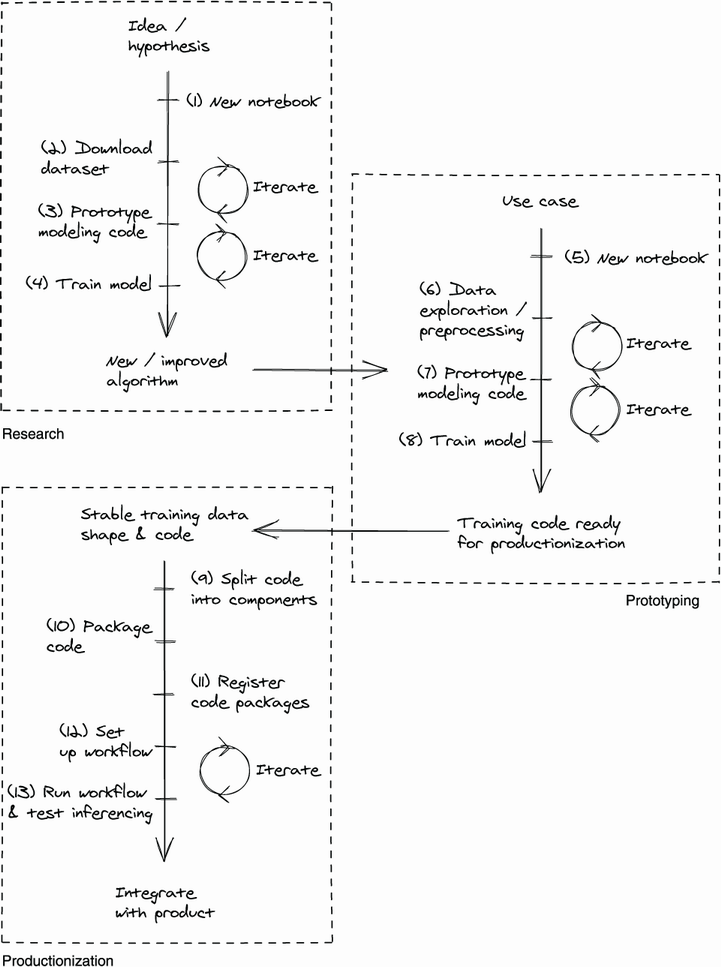
Inspect the path-to-production view to see that research and prototyping iterate repeatedly before productionization. section 10.0
