liveBook · Manning

Models object

As explained in Designing Deep Learning Systems: A guide for software engineers

A metadata entity that records identity and lifecycle information for persisted model files.

A models object records identity and lifecycle metadata for persisted model files, including model version, type, and deployment stage. One model can retain test, preproduction, and production stages. section 8.3.2

Use the models object to:

  • Link a model to the training run that produced it through a shared training_run_id. section 8.3.2
  • Locate the model’s artifact URL through the associated Training_Runs object. section 8.3.2
  • Organize model development alongside Parameters, Metrics, and Experiments objects. section 8.3.2

Lifecycle stages

An intent-classification development project can preserve separate test, preproduction, and production stages for its model while retaining links to each producing training run. section 8.3.2
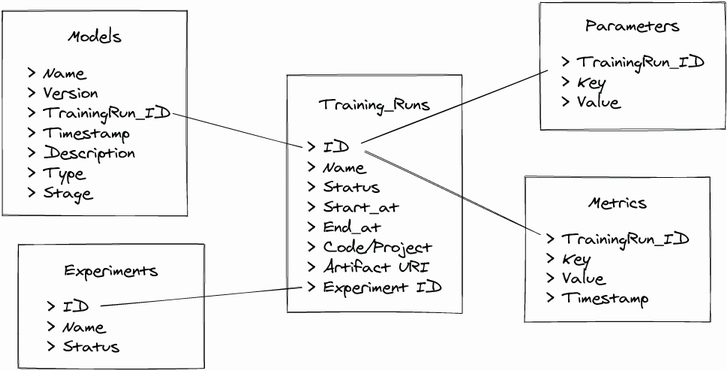
Figure 8.5 An entity relationship diagram of the data schema of the metadata storage

Use the entity relationship diagram to inspect how models objects connect to training runs and related metadata entities. section 8.3.2

How Designing Deep Learning Systems: A guide for software engineers covers it

How deep it goes
Defines fields and relationships but stops short of specifying an implementation schema or storage technology.
Examples
Uses test, preproduction, and production stages plus an intent-classification model development project.
What it assumes
Assumes familiarity with training runs, model artifacts, and metadata entities.
What you can do after
Operate a metadata store that tracks model versions, stages, producing runs, and artifact locations.
How it connects
Connects model files with Training Runs, Parameters, Metrics, and Experiments objects.

This explainer was generated by Manning's knowledge graph from the text of Designing Deep Learning Systems: A guide for software engineers. The section links point to the parts of the book it draws on.