A prediction platform is a centralized model-serving system that exposes shared infrastructure for multiple applications, model types, algorithms, frameworks, and model versions. Consolidating onboarding and maintenance in one system can cost less than operating a separate prediction service for each application. section 6.3.3 section 6.4
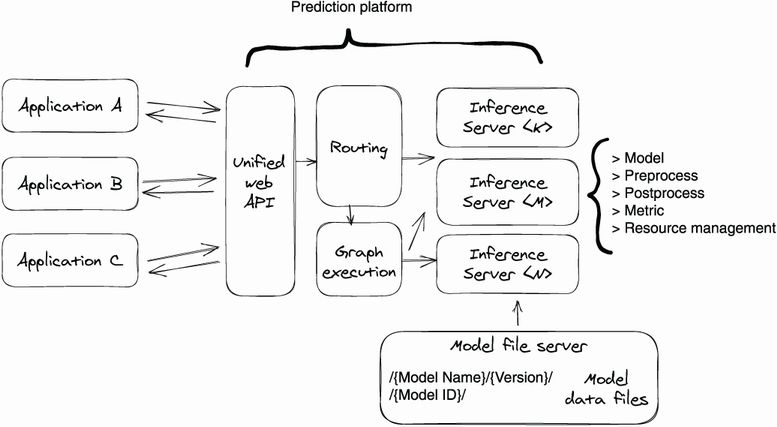
Use the reference architecture to trace how a unified API, routing, graph execution, and model-server backends organize serving for arbitrary model types. section 6.3.3
A platform brings several serving responsibilities into one system:
- Expose a generic prediction API whose request and response schemas can support different model algorithms; KFServing’s predict protocol is one example. section 6.3.3
- Coordinate routing, graph execution, and multiple model-server backends. section 6.4
- Account for model file formats, libraries, training frameworks, caching, versioning, data processing, and model management. section 6.3.3
The approach fits systems serving multiple applications with different models, such as chatbot, face-swapping, flower-recognition, PDF-scanning, and voice-recognition workloads. Choose it alongside the model server approach when serving requirements span applications and model technologies. section 6.3.3 section 6.4
