The wash-sale rule limits tax-loss harvesting: a loss is disallowed when substantially identical shares are purchased within 30 days before or after selling at a loss. It prevents an investor from claiming a tax loss while maintaining the same economic exposure. “Substantially identical” lacks a clear definition; for ETF harvesting, a practical convention treats ETFs tracking different indices as different assets. section 14.2 section 14.2.1
Harvesting VTI without a wash sale
Sell VTI at a loss and buy ITOT to remain invested in the US stock market. Under the stated ETF convention, VTI’s CRSP US Total Market Index and ITOT’s S&P Total Market Index are different enough to avoid a wash sale. But selling ITOT again a week later would not permit buying VTI: the earlier VTI loss still blocks that purchase for 30 days. section 14.2.1 section 14.3.2
Figure 14.2 The wash-sale rule applies when a second purchase follows a sale, all within 30 days.
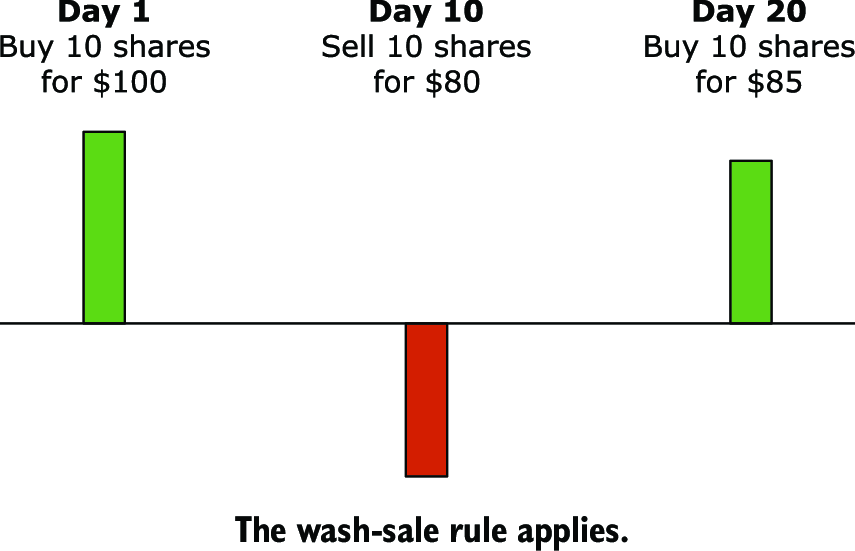
Use the transaction timeline to distinguish a sale followed by a replacement purchase within 30 days, which creates a wash sale, from an isolated loss sale. section 14.2.1
Automated checks require tax-lot purchase dates and prices, quantities, current price and date, plus sell dates and prices for closed lots. For each lot, determine whether a loss sale is blocked by recently purchased holdings; separately, determine whether a proposed purchase would wash a recently realized loss. Track partial quantities as well as whole lots. section 14.2.2
When a wash sale occurs, preserve its accounting effects in the lot records:
- Flag the washed sale and identify the replacement shares involved. section 14.2.2
- Adjust the cost basis of still-held lots involved in the washed transaction. section 14.5
- Evaluate harvesting trades against trading costs and the opportunity cost of being unable to switch back during the 30-day period. section 14.3.2 section 14.5
Wash-sale restrictions also affect portfolio construction. A rebalance may need to enlarge a replacement-ETF purchase rather than buy the harvested ETF. An optimizer can either prohibit wash-sale-producing trades or allow them with a penalty; hard constraints can leave no buyable ETF after recent harvesting, while penalties require choosing a wash-sale weight. section 14.4.1
A harvest is not automatically worthwhile. Prioritize eligible loss lots by tax benefit, choose a permissible replacement, and trade only when the expected tax benefit exceeds both trading and opportunity costs. Wash sales are not illegal, but they remove the immediate tax benefit that harvesting seeks. section 14.3.3 section 14.5
