A web of trust lets users establish confidence in public-key-to-identity associations through signatures. If Alice trusts Bob and Bob signs Charles’s key, Alice can transitively trust Charles’s key. section 10.3.2
The model works through a small chain of social verification:
- Obtain and verify Bob’s public key in person. section 10.3.2
- Rely on Bob’s signature associating Mark’s public key with Mark’s identity. section 10.3.2
- Treat key-signing parties as a possible but cumbersome way to expand the trust network. section 10.3.2 section 10.4.1
Figure 10.4 The web of trust (WOT) is the concept that users can transitively trust other users by relying on signatures. In this figure, we can see that Alice trusts Bob who trusts Charles. Alice can use Bob’s signature over Charles’s identity and public key to trust Charles as well.
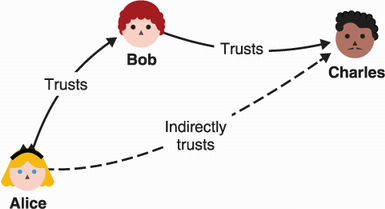
Follow the Alice–Bob–Charles chain to see how signatures support transitive trust. section 10.3.2
