A web predict API is the request boundary between an application and a model-serving predictor. The predictor loads a model file from a model artifact repository, executes the model, and returns the prediction result. In a single-model application, the predictor commonly runs as a web service in a Docker container. section 6.3.1
A production-oriented design assigns the API these responsibilities:
- Accept prediction requests from the web backend and pass them to the predictor. section 6.3.1
- Use a generic request and response payload schema when the service must support arbitrary models. section 6.3.3
- Work alongside metadata and deployment APIs that expose model version, algorithm information, and deployment status. section 6.3.3
- Allow a routing component to select an inference backend by matching model metadata with routing configuration. section 6.3.3
Single-model predictor
Convert a model-training container into a predictor container by adding the web predict API and the neural network's evaluation mode. The resulting service loads the trained model and responds to application requests. section 6.3.1
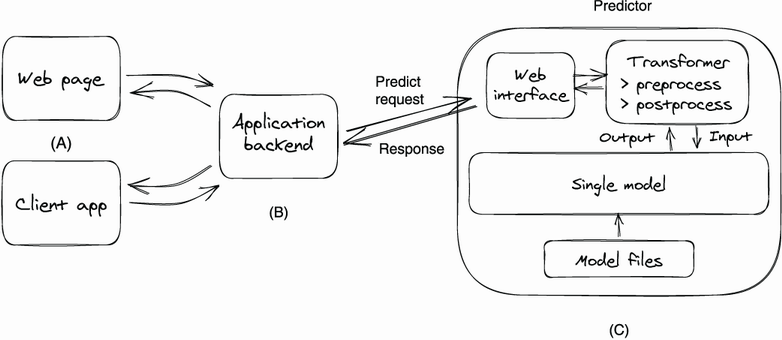
Use the single-model predictor architecture to trace the client/server request path and the predictor's role. section 6.3.1
