A wedge is the narrow customer segment or use case a product aims to win decisively before expanding. A feature that is merely useful to everyone may be indispensable to no one. section 5.4
Use a wedge to test whether the product has a compelling beachhead:
- Name one customer segment for which the product is irresistible. section 5.4
- Prefer a specific dependency or urgent use case over a broad audience. section 5.4
- Expand only after winning that segment completely. section 5.4
Cal.com’s beachhead
For Cal.com, a strong wedge is a startup whose product depends on scheduling, such as a healthcare booking platform or recruiting tool. It needs an embedded calendar without a rival’s logo, making white-labeling decisive rather than incidental. section 5.4
Figure 5.6 Cal.com and Calendly as two icebergs, each with a different product strategy. Cal.com has a small visible tip (a booking link) supported by a large, deep base of developer features: an embed system, a platform API, white-label branding, and an OAuth layer. Calendly's iceberg is the reverse: a large, branded surface with a much smaller platform underneath.
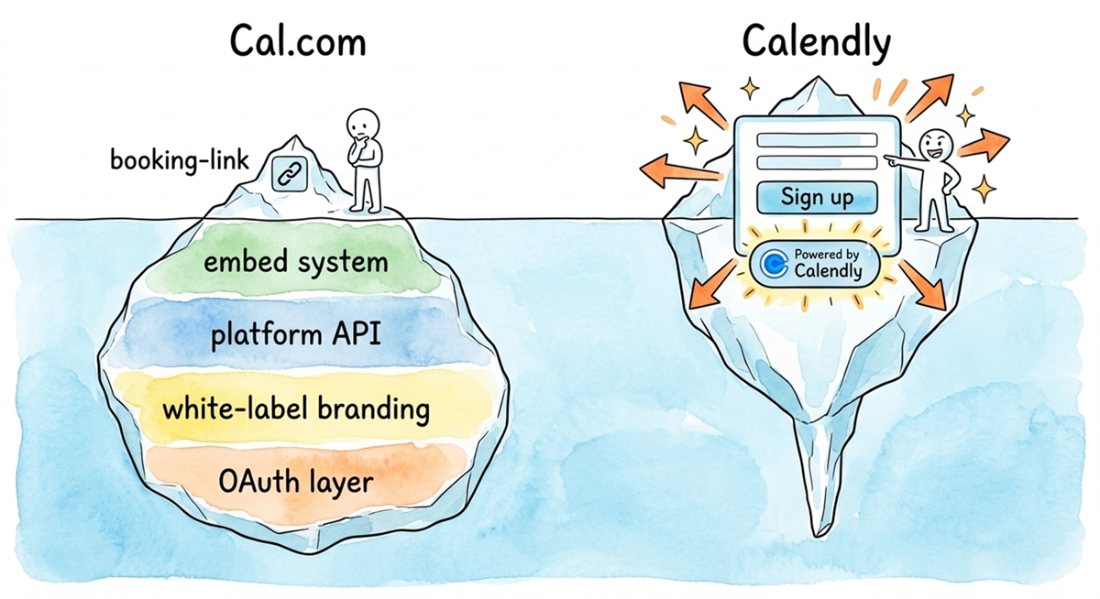
The iceberg comparison shows how a narrow visible product surface can rest on a deeper platform strategy, clarifying the relationship between an initial wedge and later expansion. section 5.4
