liveBook · Manning

Weierstrass equation

As explained in Real-World Cryptography

A short Weierstrass equation is an elliptic-curve equation of the form y² = x³ + ax + b over a specified field.

An elliptic curve is described by the coordinates x and y that satisfy an equation. The general form is y² + a₁xy + a₃y = x³ + a₂x² + a₄x + a₆. For most practical curves, this becomes the short Weierstrass equation y² = x³ + ax + b, with 4a³ + 27b² ≠ 0. The condition keeps the curve suitable for the group structure used in elliptic-curve cryptography. section 5.3.1

In cryptography, the coordinates are usually interpreted modulo a large prime rather than plotted as an ordinary real curve. The resulting points support an additive group, enabling Diffie–Hellman-style key exchange. The equation itself also matters for security: accepting a point from a different curve can enable an invalid curve attack. section 5.3.1 section 5.4
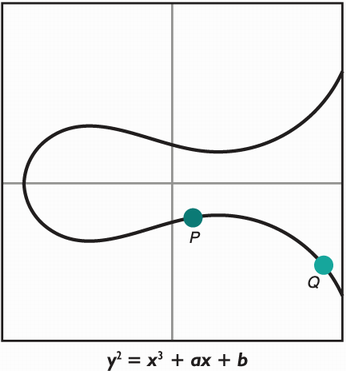
Figure 5.8 One example of an elliptic curve defined by an equation.

Use the curve illustration to connect the equation with its geometric interpretation. section 5.3.1

How Real-World Cryptography covers it

How deep it goes
Explains the general and short forms, nonsingularity condition, modular setting, and validation concern without deriving arithmetic formulas.
Examples
Uses a plotted elliptic curve, coordinates modulo a large prime, and NIST’s P-256 as examples.
What you can do after
Evaluate/understand whether a cryptographic curve uses the short Weierstrass form and why received points require validation.
How it connects
Connects elliptic curves with elliptic-curve cryptography, additive groups, Diffie–Hellman, ECDH, small subgroup attacks, and invalid curve attacks.

This explainer was generated by Manning's knowledge graph from the text of Real-World Cryptography. The section links point to the parts of the book it draws on.