A weighted majority vote combines predictions from several learners, giving each learner influence according to its score. In AdaBoost, scores come from learner accuracy: accurate learners get positive scores, chance-level learners get zero, and less accurate learners get negative scores. section 12.3
To make a binary prediction:
- Represent each learner's prediction as +1 or −1, then multiply it by that learner's score. section 12.3
- Add the weighted votes; predict class 1 when the sum is at least zero, and class 0 otherwise. section 12.3
Three friends giving advice
A highly reliable friend gets a large positive score, an unpredictable friend gets a score near zero, and a friend who is usually wrong gets a large negative score. Their weighted advice combines into one prediction. section 12.3
Figure 12.14 How to combine the weak learners into a strong learner in the AdaBoost model. We score each of the weak learners using the log-odds and make them vote based on their scores (the larger the score, the more voting power that particular learner has). Each of the regions in the bottom diagram has the sum of the scores of the weak learners. Note that to simplify our calculations, the predictions from the weak learners are +1 and –1, instead of 1 and 0.
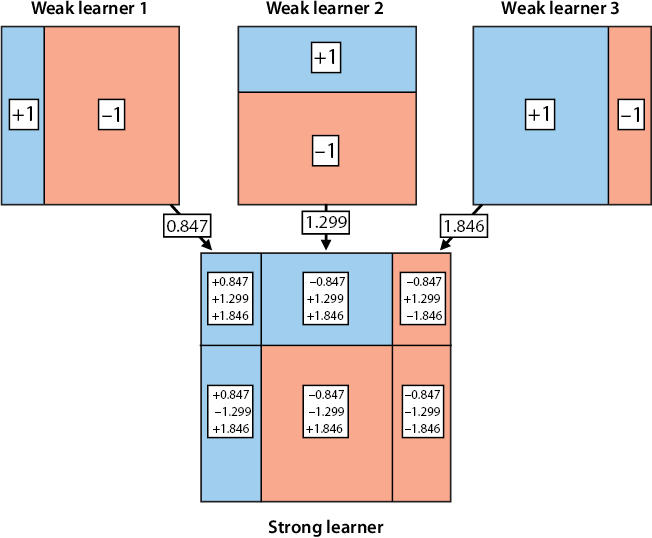
See how learner scores determine voting power and combine across regions. section 12.3
