Wired Equivalent Privacy (WEP) is the original IEEE 802.11 wireless security protocol. It aimed to provide wired-equivalent privacy through authentication, encryption, and integrity protection, but vulnerabilities made it obsolete and unsafe for current use. section 20.1.2 section 20.3
WEP’s core mechanisms are:
- Open System Authentication exchanges an authentication request and response without credentials; the access point generally approves valid requests. section 20.1.2
- Shared Key Authentication configures the same static WEP key on the access point and client. The access point sends an unencrypted challenge phrase, which the client encrypts and returns; the access point decrypts and compares it. section 20.1.2 section 20.5
- WEP uses RC4 to encrypt wireless messages and an integrity check value (ICV), a checksum derived from the message, to detect alteration. section 20.5
Shared-key challenge
A client requests authentication, receives a plaintext challenge, encrypts it with the shared WEP key, and returns the ciphertext. Matching decrypted text allows the access point to accept the client. section 20.1.2
Figure 20.3 WEP Shared Key Authentication involves exchanging a challenge phrase and encrypting/decrypting it with a shared WEP key.
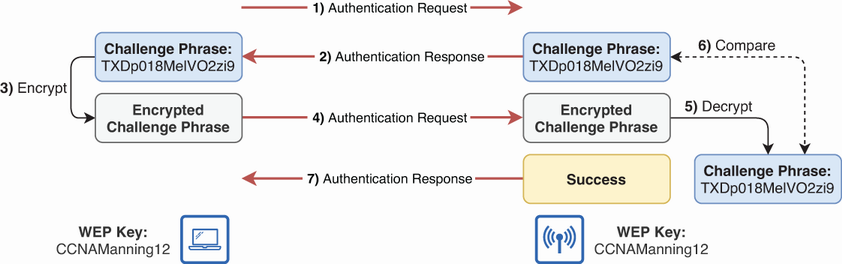
View the challenge-response sequence used by WEP Shared Key Authentication. section 20.1.2

