White-box testing verifies behavior with knowledge of internal code paths, dependencies, and implementation details. It is especially useful when public interfaces alone cannot reach subtle branches, failures, or effectful interactions. section 15.1
A testable design hides each external subsystem behind an interface, keeps business logic dependent on those interfaces, and permits every implementation to be replaced with a mock. Tests can then run business logic in a controlled environment, selecting dependency results and driving specific internal paths. section 15.2.1 section 15.2.2
Figure 15.2 Real and test environments, white-box tests, and mocks
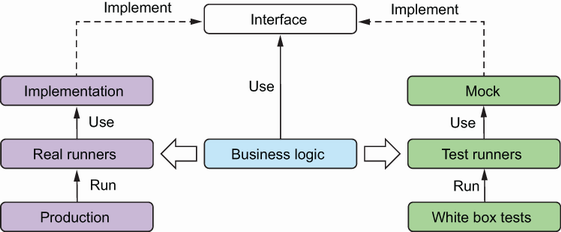
The real environment supplies live implementations; the test environment substitutes mocks so a test can control calls beneath the business logic. section 15.2.1
White-box tests can be used to:
- Lock down sensitive business-logic behavior and protect it from regressions. section 15.2.3
- Simulate external-service outages and verify the application’s response. section 15.2.3
- Exercise IO-bound scenarios, including effects, algorithms, and service interactions. section 15.2.3
- Record expected behavior as executable documentation or investigate stability with fuzzy testing. section 15.2.3
Testing a failed game load
A game-loading test supplies a mocked database connection and a successful labyrinth lookup, then makes the player-position lookup return a database error. The test runs loadGame and asserts that the expected exception is raised. After refactoring, a safe wrapper can convert exceptions into Either results while mocks still steer the failure path. section 15.2.3 section 15.2.3
Control has a cost. Comprehensive internal-path coverage can become laborious, brittle, and expensive to maintain, slowing delivery. Prefer meaningful tests aimed at important requirements and risks rather than treating full coverage as the goal. section 15.2.3 section 15.3
A configurable test runtime can mix mocked, test, and real interpreters, trace call stacks and transferred data, simulate service responses, and support deterministic ordering for concurrent work. Such infrastructure can serve unit, integration, or functional tests. section 15.2.4


