The Wilcoxon signed-rank test compares two dependent sets of continuous or ordinal measurements, such as scores from the same participants before and after a study session. It is a non-parametric alternative to a within-subjects t-test when the normality assumption cannot be met. section 5.2.1
To calculate the W-statistic:
- Find the difference within each pair and rank the absolute differences. section 5.2.1
- Give each rank the sign of its original difference, then add the positive and negative ranks separately. section 5.2.1
- Use the lower rank sum as W and compare it with a critical value. section 5.2.1
Figure 5.8 Steps for calculating the W-statistic
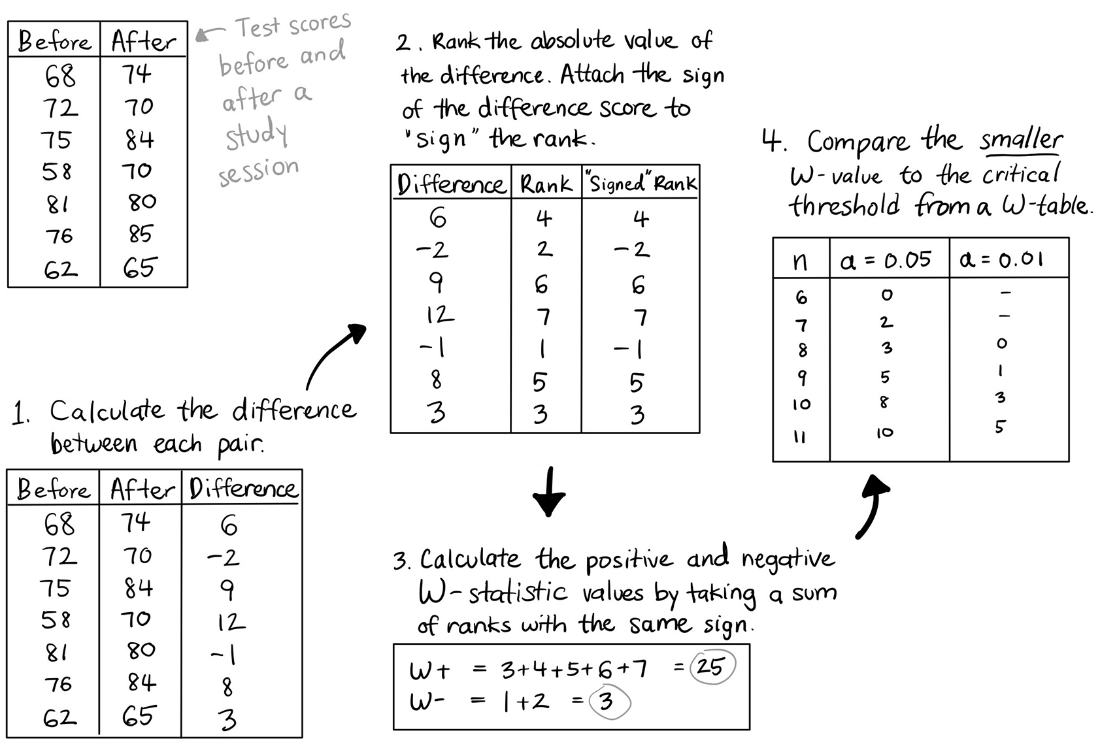
Follow the calculation on paired test scores recorded before and after a study session. section 5.2.1
Choose the test by the study design as well as the data: Wilcoxon signed-rank is for two dependent samples, while Mann–Whitney U is for two independent samples. Not requiring normally distributed data does not make the test assumption-free; two other assumptions still need checking. When reporting a rank-based comparison, show medians rather than relying on means, which may suggest a different interpretation. section 5.4 section 5.2.1
