When an internal tool becomes a multi-tenant service, embedded access checks may not protect tenant boundaries, support access, data residency, or compliance. An authorization layer is a distinct boundary that evaluates or enforces authorization rules for requests crossing it. section 13.1
A layered authorization design can divide responsibility:
- A platform authorization layer enforces global rules such as tenant isolation, support access, data residency, and compliance. section 13.1
- Tenant-level authorization evaluates collaboration rules inside each tenant namespace, preserving relationship-based access control (ReBAC) for owners, editors, viewers, and delegated sharing. section 13.1
- The layer also establishes an enforcement boundary for AI: authorization determines permitted data and actions before prompt construction, while the model operates only within that approved context. section 17.1
Authorized context for AI
For a request involving protected data, the authorization layer evaluates the principal, action, resource, policy, and current system state. It supplies the AI system only the approved data and actions; the model neither queries sensitive data directly nor decides access. section 17.1
Figure 13.1 Evolution of the Customer Collaboration platform. The internal Customer Collaboration Platform (top) is compared with the multi-tenant Customer Collaboration Cloud (C³) (bottom).
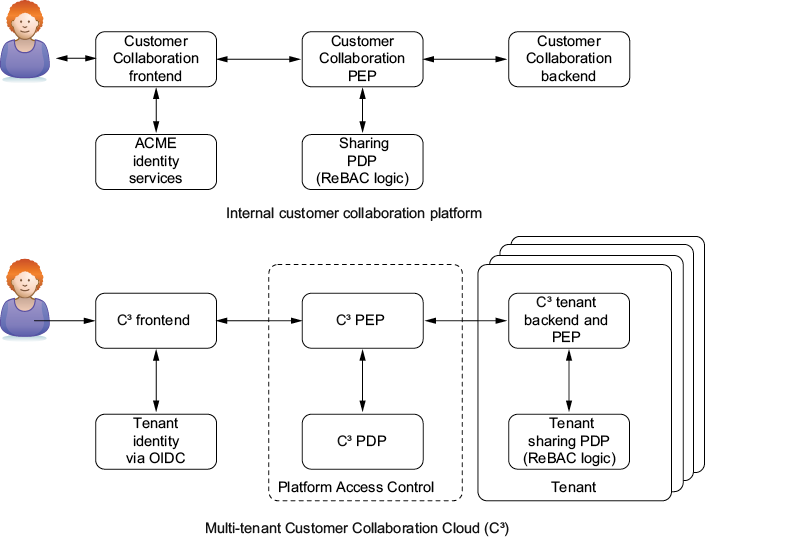
Compare a single-tenant system with embedded checks to a multi-tenant design that separates platform authorization from tenant-level sharing authorization. section 13.1
