When users, devices, workloads, and services operate across cloud systems, mobile environments, SaaS applications, and external collaborations, network location no longer provides reliable trust. Continuous authorization replaces inherited trust with repeated access evaluation based on identity, device, conditions, and purpose. section 15.1
Authorization is continuous when access is evaluated every time it matters rather than granted durably after one authentication or authorization event. Decisions can incorporate changing relationships, real-time context, actions by people or services, device posture, operational signals, and policy. section 15.1 section 19.9
A practical transition toward continuous authorization includes:
- Make an unclear or inconsistently enforced permission visible. section 19.9
- Externalize one policy domain and evaluate it consistently. section 19.9
- Govern identity, role, attribute, relationship, device, and operational signals so they remain defined, validated, and current. section 15.1
- Evaluate the policy at runtime using conditions that reflect how the system actually operates, then learn from the outcomes. section 19.9
ACME's collaboration platform
ACME began with document sharing, but access decisions grew beyond simple role checks. Relationships, attributes, and real-time context increasingly shaped behavior across services, teams, and customer interactions. The organization improved incrementally by making decisions consistent and integrating them with identity and policy capabilities. section 19.0
Figure 15.1 Why the perimeter model fails in modern environments. In the traditional model (left), a firewall defined a clear boundary, and anything inside the perimeter was implicitly trusted. In modern environments (right), cloud services, mobile work, SaaS applications, and external collaborators eliminate meaningful boundaries.
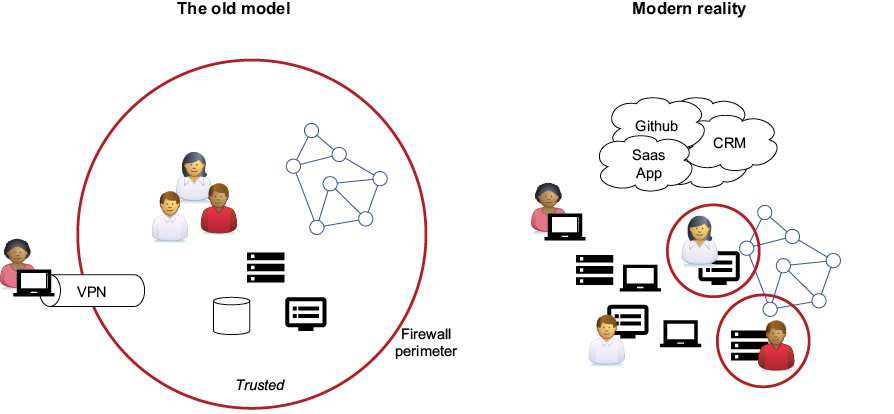
Contrasts a firewall-centered model, where internal location implies trust, with modern environments whose cloud, mobile, SaaS, and external boundaries make that assumption unreliable. section 15.1
