liveBook · Manning

Witness path

As explained in Optimization Algorithms: AI techniques for design, planning, and control problems

A path that is no more expensive than the path through a candidate contracted node and therefore proves that a shortcut is unnecessary.

A witness path is an alternative route between two neighbors of a node being contracted. If its cost is no greater than the route through that node, the alternative preserves their shortest distance: no shortcut is needed. section 4.3.4

A four-node contraction

Contracting node 1 needs no shortcut between nodes 2 and 4 because their shortest path does not pass through node 1. Contracting node 2, by contrast, changes shortest paths and calls for shortcuts. section 4.3.4

Figure 4.24 Witness path—there is another path from P to w that is shorter, so no shortcut is needed when contracting v.
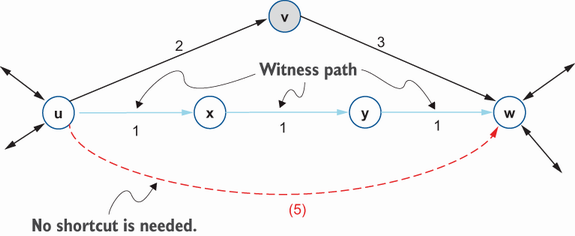
The diagram contrasts a route through the contracted node with a shorter alternative that makes a shortcut unnecessary. section 4.3.4

This comparison is part of contraction-hierarchy preprocessing. Shortcuts that are needed go into an augmented graph used later for faster queries; a witness path prevents adding one unnecessarily. section 4.3.4

How Optimization Algorithms: AI techniques for design, planning, and control problems covers it

How deep it goes
Defines the cost comparison and illustrates its effect during contraction, without detailing a dedicated witness-path search.
Examples
Uses a four-node graph where one contraction needs no shortcut and another creates shortcuts.
What you can do after
Evaluate/understand whether an alternative path makes a proposed contraction shortcut unnecessary.
How it connects
Links shortest paths, node contraction, shortcuts, augmented graphs, and contraction hierarchies.

This explainer was generated by Manning's knowledge graph from the text of Optimization Algorithms: AI techniques for design, planning, and control problems. The section links point to the parts of the book it draws on.