liveBook · Manning

Compromise record

As explained in Software Architecture Decision-Making

A compromise record is a lightweight book-specific record that captures an intentional delivery compromise, its reason, risk, owner, and revisit trigger.

A compromise record makes delivery trade-offs visible when time-to-market narrows the architectural option space. It captures intentional simplification without allowing the resulting debt to become invisible. section 2.1

Keep each record lightweight but actionable:

  • Compromise: what was simplified, limited, or postponed. section 2.1
  • Reason and risk: why the decision was necessary and what exposure it creates. section 2.1
  • Owner and revisit trigger: who carries the decision and what future event reopens it. section 2.1

A time-constrained release

Limit test automation to critical paths when a deadline prevents full coverage; record increased regression risk, assign the delivery team and technical lead, and add missing tests before the next feature release or usage expansion. section 2.1

Figure 2.2 Time-to-market compresses the architectural option space. The less time available, the fewer classes of solutions remain realistic.
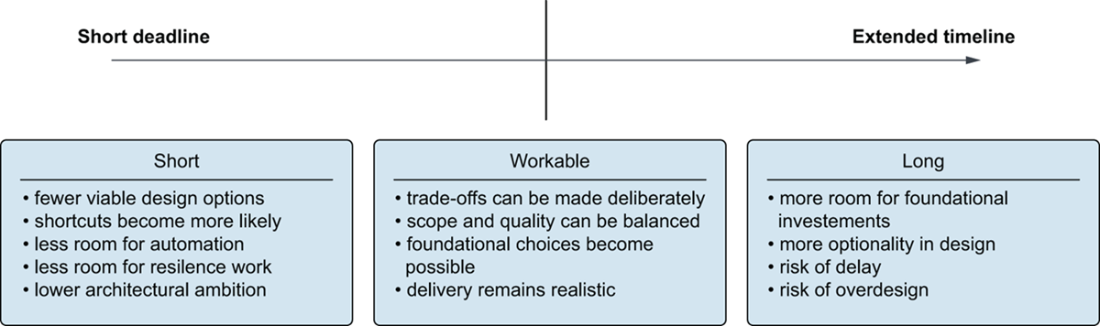
The figure frames time-to-market as a force that removes classes of otherwise realistic architectural solutions. section 2.1

How Software Architecture Decision-Making covers it

How deep it goes
Defines fields and supplies concrete records, but stops short of prescribing a heavy governance process.
Examples
Uses limited test automation, simplified implementation paths, and postponed design refinements as recorded compromises.
What it assumes
Assumes competing delivery constraints and distinguishes intentional, owned debt from forgotten architectural debt.
What you can do after
Apply a lightweight record to assign compromise ownership, expose risk, and define evidence-based revisit triggers.
How it connects
Connects time-to-market with architectural debt, test automation, production feedback, and deployment infrastructure as code.

Related concepts

This explainer was generated by Manning's knowledge graph from the text of Software Architecture Decision-Making. The section links point to the parts of the book it draws on.