liveBook · Manning

Mini-protocol

As explained in Real-World Cryptography

A mini-protocol is a small, custom protocol created for a specific application rather than adopted as an established standardized protocol.

A mini-protocol is a small, custom protocol built for an application when existing standardized protocols do not fit. That flexibility can become dangerous: incorrect assumptions about a primitive’s threat model or composability can create vulnerabilities. section 16.2

Treat a mini-protocol as a security design problem:

  • Identify the threat model: determine what each cryptographic primitive protects against. section 16.2
  • Check composability: examine how primitives behave when combined with one another or embedded in a larger protocol. section 16.2
  • Model the protocol and test its security properties with formal verification rather than relying only on intuition. section 16.2
Figure 16.1 The Tamarin protocol prover is a free formal verification tool that you can use to model a cryptographic protocol and find attacks on it.
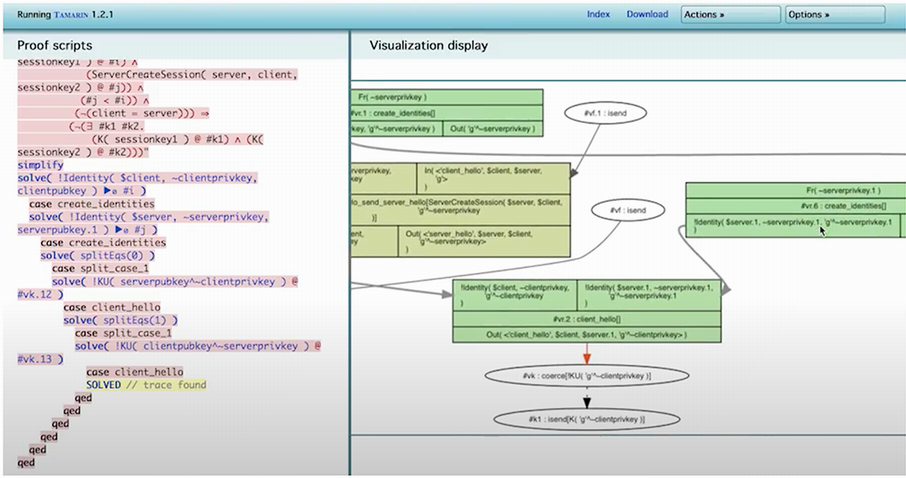
Use the Tamarin protocol prover to model a cryptographic protocol and search for attacks. section 16.2

How Real-World Cryptography covers it

How deep it goes
Explains threat-model and composability failures, then points to formal verification without detailing a complete protocol proof.
Examples
Uses Tamarin as a tool for modeling cryptographic protocols and finding attacks.
What it assumes
Assumes familiarity with cryptographic primitives and protocols while emphasizing threat models and composability risks.
What you can do after
Diagnose custom-protocol weaknesses by modeling the design and testing security properties with formal verification.
How it connects
Connects cryptographic primitives, threat models, composability, formal verification, and protocol downgrade attacks.

This explainer was generated by Manning's knowledge graph from the text of Real-World Cryptography. The section links point to the parts of the book it draws on.