A working agreement is a collectively accepted norm that defines how participants behave and interact during a group activity. It gives the group shared terms for collaboration without taking ownership of the outcome away from participants. section 5.4.5
Use working agreements to make participation expectations explicit:
- Agree on collaboration conditions before changing styles, such as moving from chaotic exploration to splitting or walkthroughs. section 5.4.5
- In remote sessions, agree that cameras remain on as much as possible and discuss exceptions early to prevent misunderstanding. section 5.5.2
- During check-ins, protect the right to pass and make clear that participants listen without interrupting. section 4.4.1
- When agreements are absent, establish collaboratively accepted safety rules that provide a shared basis for addressing violations. section 6.5
A remote modeling session
Before collaborative modeling begins, the facilitator asks the group to agree that cameras stay on whenever possible. A participant may turn theirs off for a good reason, but discussing that expectation at the start reduces later frustration. During the opening check-in, everyone may pass and listens without interrupting. section 5.5.2 section 4.4.1
Figure 4.12 Example check-in we used at BigScreen. We start with a personal question to create more group understanding. Questions 3 and 4 focus on the session’s content, ensuring participants engage and reflect on the topic at hand. Our goal is to avoid opinions on the content and instead delve into what participants know and their questions. Remember to customize your check-in questions for each session and refresh the format regularly to keep it genuine.
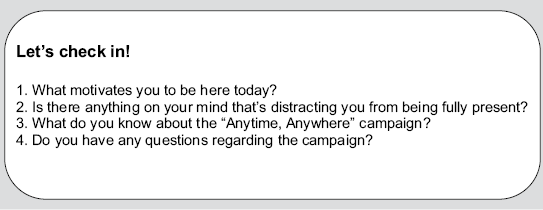
Use the check-in example to adapt opening questions and participation agreements to the group, session goals, and social dynamics. section 4.4.1
