Indexes help a database find records faster, but they add work whenever data changes. That extra latency is the write penalty: each INSERT, UPDATE, or DELETE may require the database to maintain its indexes. section 8.5.1
Filing paperwork
With no index, filing a document is like tossing it into one bin. With indexes, you also file copies in folders such as “By Date,” “By Author,” and “By Subject.” Finding a document gets easier, but filing takes longer. section 8.5.1
A table with zero indexes needs one write to store a row. With five indexes, the database also performs five index-maintenance operations. More indexes can speed up reads, but make writes heavier. section 8.5.1
Figure 8.11 The Tradeoff: Indexes speed up reads (finding the file) but slow down writes (you have to file the paper in multiple places).
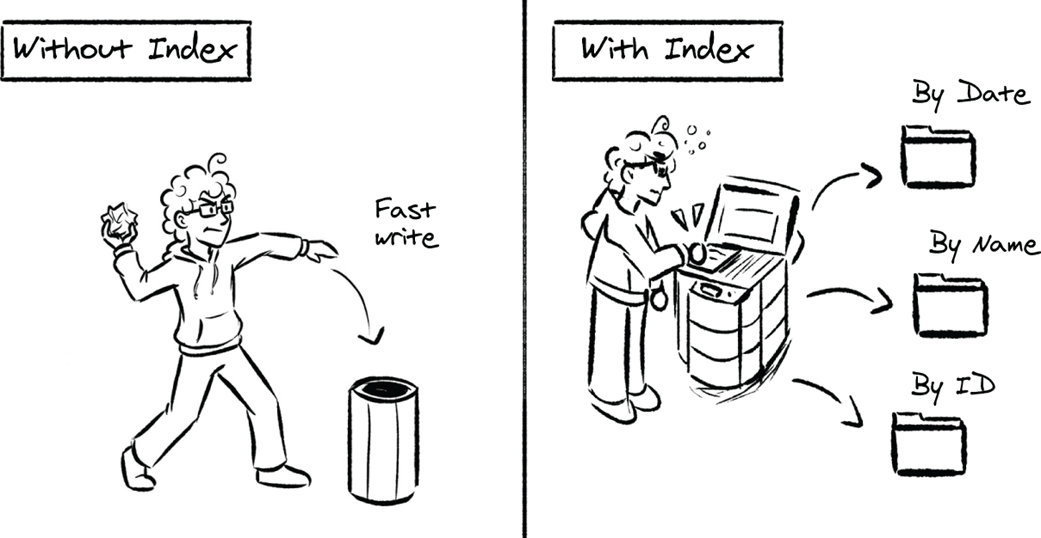
Use the filing-cabinet comparison to see how indexes trade faster lookups for slower writes. section 8.5.1
Treat indexes as a tradeoff, not a free speed boost: choose them to help reads that need it, while accounting for the extra work on every data modification. section 8.10
