XMSSMT is a multi-tree form of XMSS: smaller Merkle trees form a hypertree, and one-time signatures sign the roots of other trees. This increases supported signatures while limiting regeneration work to trees on the signing path. section 14.2.3
The design balances signature capacity, signing work, and operational risk:
- A hypertree connects multiple Merkle trees, with one-time signatures in lower-level leaves signing higher-level tree roots. section 14.2.3
- Only trees along the path to the selected one-time signature are deterministically generated when needed. section 14.2.3
- XMSSMT remains stateful: reusing a signing path through rollback or multiple servers can reuse a one-time signature and enable forgery. section 14.2.3
Figure 14.6 The XMSSMT stateful hash-based signature scheme uses multiple trees to increase the amount of signatures supported by the scheme while reducing the work at key generation and signing time. Each tree is deterministically generated only when they are used in the path to the final leaf that contains the OTS used to sign a message.
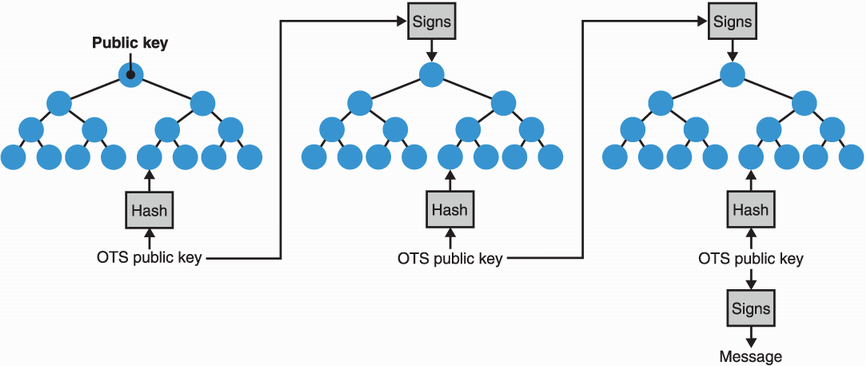
The diagram shows how multiple deterministically generated trees reduce key-generation and signing work. section 14.2.3
