XState models complex application flows as state machines while also supplying a data-management approach for React. It provides a deliberate alternative to Redux, Zustand, and reducer-based patterns when the important problem is understanding what can happen next. section 8.0 section 8.9
Choose XState when explicit flow modeling matters more than minimizing implementation surface:
- Use it to separate presentation from data management, allowing the application’s data layer to change without rewriting its components. section 8.0
- Prefer it for complex flows where explicit possible transitions can improve understanding and reduce bugs. section 8.9
- Compare it pragmatically with Redux and Zustand: the tools are largely interchangeable, while Zustand favors simplicity and can become harder to organize at scale. section 8.9
Word game flow
A Wordle-style game can place its main game logic in XState. Guards and actions attached to transitions implement the game behavior, while reveal and win animations account for much of the flow’s visible complexity. section 14.4
Figure 14.3 The XState flow diagram is surprisingly simple and is this complex only because of the reveal and win animations. Without those animations, it's even simpler. Guards and actions associated with the arrows make the game work as intended.
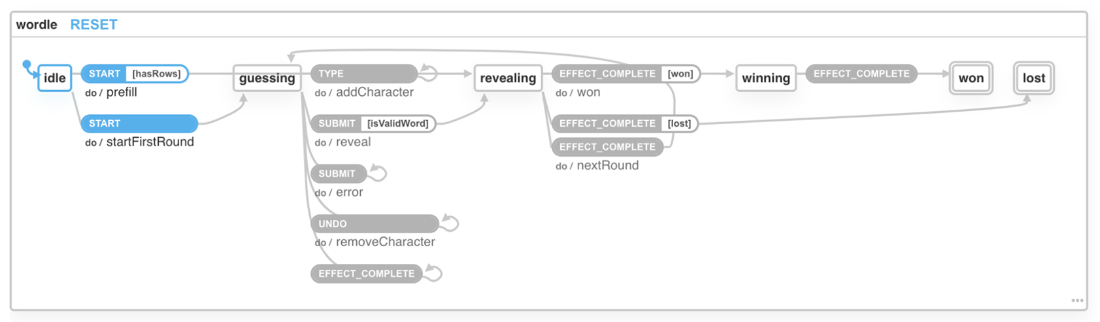
Inspect the XState flow diagram to see how transitions, guards, actions, and animation states combine into the game’s logic. section 14.4
