YOLO (You Only Look Once) is a family of real-time object-detection models that predicts object classes and locations from an image in one inference pass. In production, it belongs inside a reproducible pipeline rather than an isolated notebook experiment. section 7.0 section 8.1
A production YOLO training component handles three connected responsibilities:
- Downloads training, validation, and test images together with their labels into the expected folders. section 8.1
- Configures the dataset path, split paths, and image-to-label correspondence. section 8.1
- Runs model training and evaluation through the Ultralytics YOLO library, while leaving room for customization. section 8.1
- Packages the process as versioned, repeatable components that integrate with data preparation, monitoring, and evaluation infrastructure. section 8.0 section 8.1
ID card detection
An ID card detector uses a YOLO variant within a Kubeflow object-detection pipeline. Data preparation supplies organized images and labels; the training component configures the dataset, trains the model, and evaluates its results. section 7.0 section 8.1
Figure 8.1 The mental map where we’re now focusing on the fourth and fifth step/component of our pipeline—model training (4) and evaluation (5)
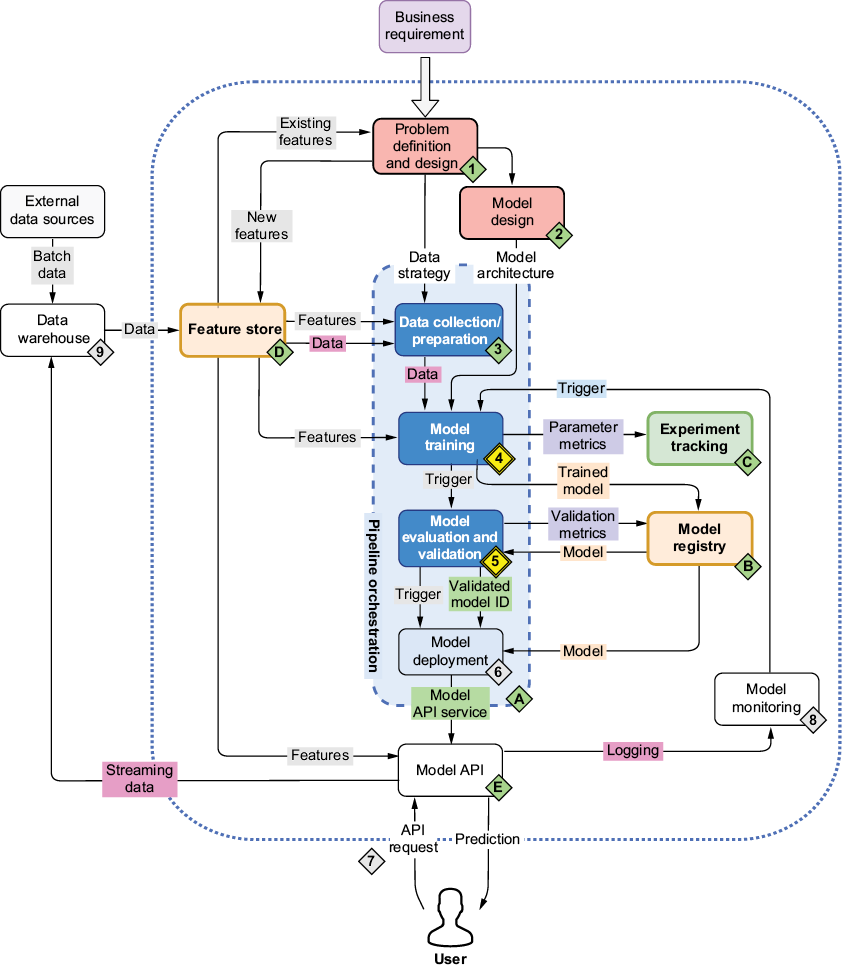
Use the pipeline map to place YOLO within the model-training and model-evaluation stages. section 8.0


