Zanzibar is a globally scalable authorization system that decides access from relationships among users, resources, and permissions. Instead of asking whether a role grants access, it asks whether a principal has a specific relation to a resource, such as viewer, editor, or owner. section 6.1
A relationship graph represents principals and resources as nodes, with connections defining permissions and their justifications. This supports fine-grained, dynamic decisions for shared documents, folders, groups, calendars, support tickets, and deployment plans. section 6.1 section 8.0
Collaborative document access
Sharing a document with a colleague illustrates the model: the colleague becomes a viewer, commenter, or editor through a relationship with that document rather than through a centrally assigned role. Indirect relationships, such as “manager of the owner,” can also influence authorization. section 6.1
Figure 6.1 A relationship graph used by ACME Corp’s Customer Collaboration platform. Employees like Bob and Alice are linked to customer accounts through roles such as support engineer and solution architect. Access to resources such as support tickets and deployment plans is controlled by these relationships, allowing for dynamic, fine-grained authorization decisions based on who is connected to what and how.
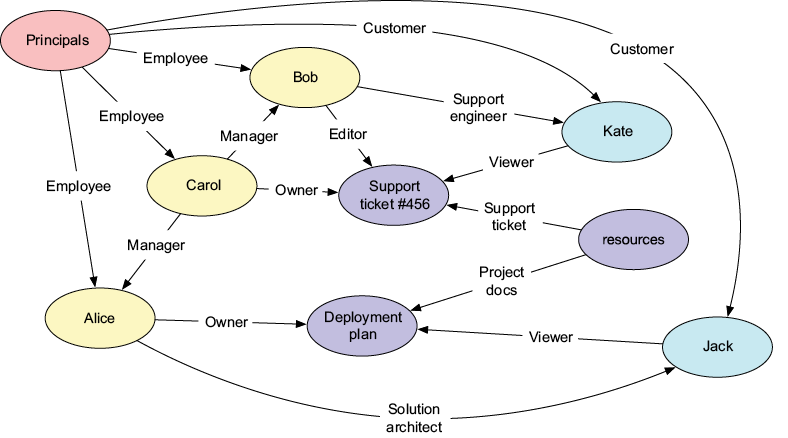
A relationship graph connects employees and customers to accounts and shared resources, showing how roles and responsibilities produce dynamic access decisions. section 6.1
